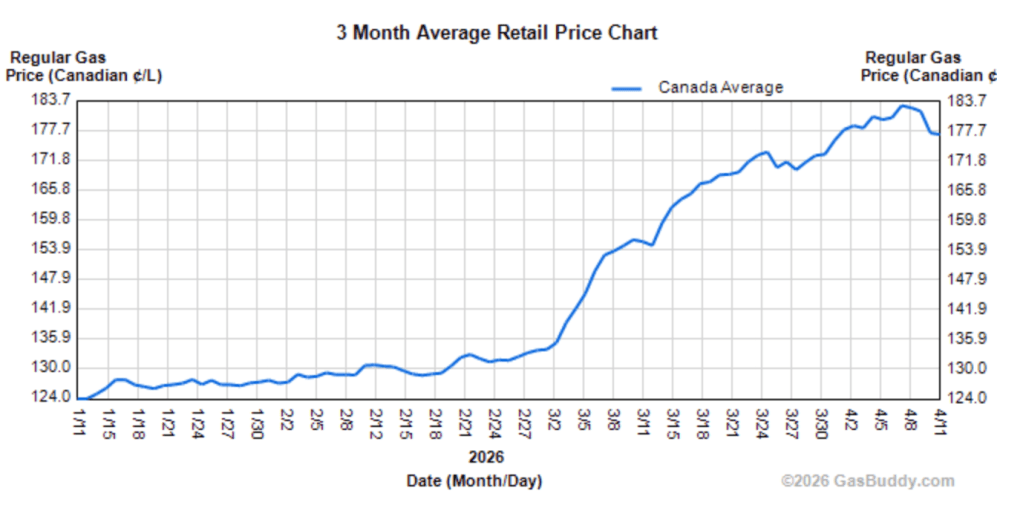
Across Canada, gas pump prices are the talk of the town. Since the U.S. and Israel launched attacks on Iran at the end of February, the average price of a litre of gasoline in Canada has spiked 45 cents—a 34 percent jump—to over $1.75/litre. Drivers are, understandably, none too happy.
A survey by the Angus Reid Institute (ARI) found that 58% of Canadians have made some sort of change to their behaviour to offset these higher prices, with 43%) saying they are driving less and 14% noting they’ve had to cut spending elsewhere. Unsurprisingly, Canadians living in households earning more than $100,000 are more likely to say they’ve made no changes to their habits (47%) relative to those living in lower income households (29%).
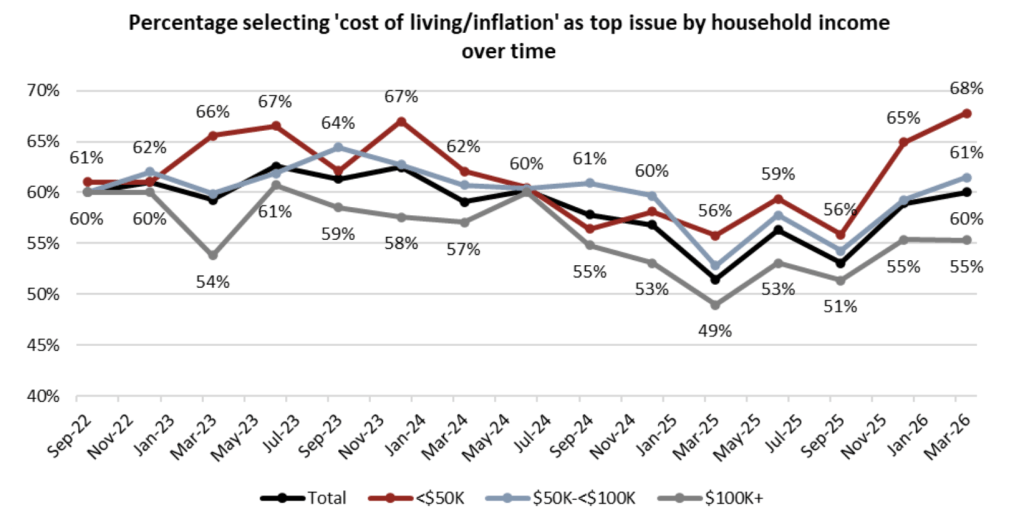
Affordability is already strained for many households. A separate ARI survey’s Financial Pressure Index found 23% of Canadians are facing High financial pressure, 18% Medium, 35% Low, and 24% Very Low. It also found that concern over cost of living has reached a three-year high in lower-income households amid this gas price spike, with 68% of households with sub-$50,000 income selecting cost-of-living/inflation as their top concern.
It’s entirely appropriate—and expected—that the federal government is considering its options to alleviate this pain-point. Pierre Poilievre, leader of the official opposition Conservatives, was quick to weigh in with advice of his own, and his remedy is—perhaps unsurprisingly—to cut taxes (the fuel excise tax and GST) and climate policy (the Clean Fuel Regulation).
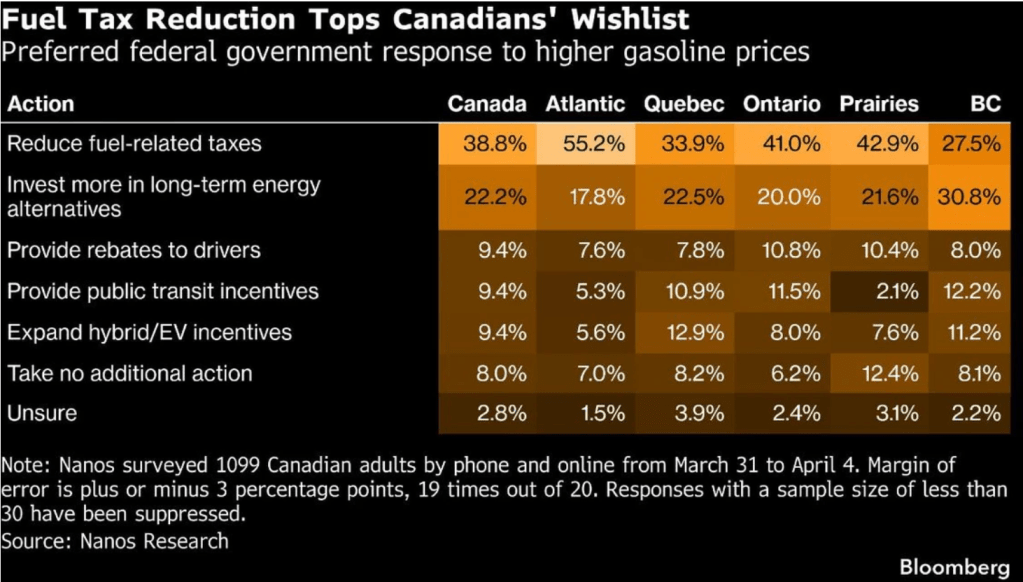
What do Canadians want? Bloomberg commissioned a survey by Nanos to dig into the topic. It found that reducing fuel-related taxes would be the most popular federal government response, with 39% support. But while it was the most popular single option, it’s noteworthy that a cumulative 41% preferred options that would better protect Canadians from future gasoline price shocks, such as investing more in long-term energy alternatives (22.2%), providing public transit incentives (9.4%), expanding hybrid/EV incentives (9.4%).
And there’s the rub—when it comes to our ongoing reliance on oil, we just keep digging ourselves into a deeper hole. At the moment, that’s become acutely painful. Do we want an aspirin so we can keep digging, or should we consider getting out of the hole?
Perhaps that’s too glib, considering the very real, very acute economic hardship that many Canadians are facing right now. Some pain relief is warranted, but it’s important to acknowledge that not all Canadians are experiencing the same degree of hardship, and an across the board axing of the excise fuel tax or GST on gasoline is the proverbial chainsaw approach, when a scalpel will do.
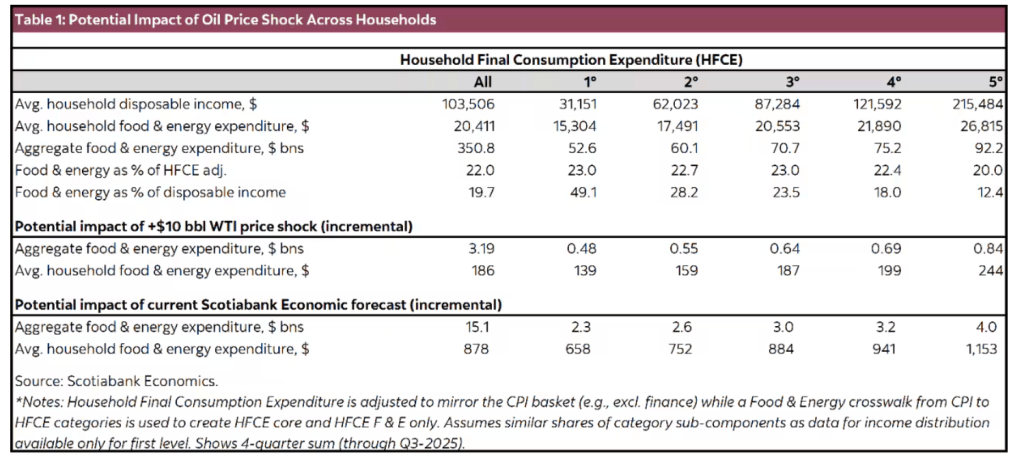
As Rebekah Young and Oliver Gervais noted in a Scotiabank brief, “There are some calls for cutting gas taxes with several European countries temporarily suspending fuel levies. While such measures are broad‑based and highly visible—and would offer some near‑term relief to low‑ and middle‑income households, who spend a larger share of their income on transportation—they are also regressive, delivering the largest benefits to higher‑income households with greater fuel consumption.“
The Scotiabank analysis finds that for each sustained $10/barrel increase in oil prices, Canada’s two lowest income quintiles see an incremental $1 billion hit in food and energy costs, which translates into an additional ~$150 per household. As the authors note, “the regressive impact is stark relative to disposable income where the lowest quintile spends almost half of disposable income on food and energy versus under 20% for the average household leaving limited flexibility to adjust.”
Their prescription? Targeted support to those least able to cope.
The delivery mechanism? A temporary increase to the quarterly GST Groceries and Essentials Benefit. Such targeted support would be consistent with approaches taken elsewhere, including Korea, New Zealand and Ireland.
Not only would this approach deliver support to those most in need of it, it would avoid a counterproductive blunting of price signals, “weakening incentives to conserve fuel or switch to alternatives.” Furthermore, given that “once implemented, fuel tax cuts tend to be politically difficult to unwind,” the federal government’s budget is much better served by this targeted relief, (to address the pain) which can be coupled with strategic policy and investments to conserve fuel and switch to alternatives (to help get us out of this hole).
The Clean Fuel Regulations (CFR) and associated federal supports for biofuel production, EV incentives, and EV charging infrastructure programs all serve to establish alternatives that will increasingly insulate Canadian consumers from future oil price shocks.
The CFR incentivizes blending made-in-Canada biofuels into gasoline, as well as investments in the EV charging network (including home chargers)—while this does come at a cost at the pump, it should be considered an investment in energy security and transportation price stability. As the President of Advanced Biofuels Canada noted, “It’s easy, but inaccurate, to suggest that Canadians’ home finances would be stronger without biofuels, but the data do not support that theory. Furthermore, a domestic biofuel industry that utilizes Canadian farm crop feedstocks insulates us from the instability caused by global trade tensions by shoring up domestic supply of transportation fuels and lessening reliance on foreign markets and volatile trade policies.”
Meanwhile, the federal government’s auto industrial strategy—including proposed vehicle tailpipe emission standards—will support the evolution of the Canadian auto sector, save future buyers of gas cars and trucks thousands of dollars per year at the pump thanks to better fuel efficiency, and spur more supply and choice of EVs that avoid the gas pump altogether. Just last week, Clean Energy Canada released updated analysis (and a handy calculator) showing how EVs save typical drivers about $23,000 to $32,000 over 10 years of ownership (and that’s based on average 2025 gas prices of $1.42 per litre, before the recent price spike).
[As an aside, it’s somewhat baffling that the federal Conservatives prefer President Trump’s tailpipe standards, which will end up costing Americans an additional $185 billion at the gas pumps over the next 25 years. How does this help affordabilty?]
As I’ve previously written, even as a major oil producer Canada is not immune to geopolitically-driven price shocks. That path to energy security—and price stability—runs through greater electrification.
Prime Minister Carney has shown an affinity for practical, prudent and pragmatic responses to the various “ruptures” that dominate both headlines and our daily lives. When it comes to the current “rupture” in energy markets the practical, prudent and pragmatic response is two-pronged:
(1) Provide temporary and targeted relief to those Canadians most acutely impacted by high gas prices.
(2) Stay the course on the policies and programs that will reduce our exposure to future oil price shocks by pivoting to domestic clean energy (biofuels, electricity etc.), and more efficient and ultimately electric vehicles.
It’s well past time we stop digging a deeper hole.
 Polaris Strategy + Insight