This opinion editorial was originally published in National Newswatch.
With the spreading Middle East conflict disrupting oil and gas markets, we’re reminded that producing those commodities doesn’t insulate Canadian households and businesses from geopolitical price spikes. But electricity does.
Canada holds a strategic advantage: among the lowest electricity costs in the OECD and one of the least emissions-intensive grids, powered largely by world-class hydro and nuclear built over generations, with rates regulated for stability. In an era defined by energy insecurity, it’s a competitive edge. The task now is to strengthen it.
Oil and LNG are globally traded commodities, and while a disruption in Middle East production and transport through the Strait of Hormuz may only limit some physical imports, the ensuing price spikes are global, meaning higher pump prices and heating bills in Canada, too. These spikes—and the inflation that follows—are driving many import-dependent countries to pivot toward energy they can produce and control themselves, including wind, solar, batteries, heat pumps and EVs.
With prices once again on the rise, the lesson is clear: energy security depends on more electricity capacity and the electrification of industry, transport and buildings. This reality raises two important questions for Canada.
First, what steps will we take to electrify and better ensure Canada’s energy security?
Prime Minister Carney is developing an electricity strategy aimed at doubling supply. Given the economics, most of what gets built will be clean, simply because it’s the cheapest option. But Canada must also increase electricity’s share of meeting the energy needs of Canadian businesses and households. Doubling electrification would further reduce exposure to global energy shocks, and if paired with stronger efficiency measures, could double Canada’s energy productivity. That means producing more economic output with less energy — the definition of modern competitiveness.
This “double-double-double” approach could catalyze billions in investment, create career opportunities across the country, boost businesses productivity, lower energy costs and bolster supply chains—from raw resources through manufacturing—and services that Canada can also export abroad.
The second question is: What new economic opportunities does this create both at home and with our trading partners?
While visiting Ottawa last week, a senior EU official told reporters that future energy trade agreements with Canada would prioritize “clean energy sources,” noting “Seventy per cent of Europe’s electricity comes from either renewables or nuclear. This is the way forward. It is simple.” And while increased global prices for LNG exports to other regions can be a revenue generator for Canada short-term, a focus on diversifying what we export is critical if we are to insulate our country from a boom-and-bust revenue cycle, the consequence of which we saw clearly in Alberta’s 2026 budget.
The clean economy is no longer emerging—it’s scaling. With $2.3 trillion invested globally in the energy transition last year alone, opportunities for a more resilient economy lie in the clean energy supply chain—from the critical minerals and processed metals to batteries and grid equipment that rapidly electrifying trade partners are looking for. A recent analysis found that Canada’s exports in clean energy supply chains grew 21 per cent faster than all other exports over the last five years, and Canada’s market share of these exports is growing. This success can be turbo-charged with industrial policy targeting those segments of the clean energy supply chain where competitive advantage has been demonstrated.
The growth in demand for these materials and products can strengthen traditional Canadian industries. For example at the Prospectors and Developers Association Conference this week, Minister Hodgson announced 30 new critical minerals partnerships that will unlock $12.1 billion in projects to “strengthen supply chains, support economic growth and reduce strategic vulnerabilities.”
Electrification can enable energy security, economic competitiveness, and industrial renewal – all at once. By working with provinces to broaden our national electricity strategy—ensuring it aims to double supply, electrification and productivity—Canada can capture domestic and export opportunities that will build lasting prosperity, security and resilience for generations to come.
Today, the federal government launched a new auto industry strategy that (among other things) included a pivot from the Electric Vehicle Availability Standard to stronger vehicle GHG emission regulations. The strength of these regulations will be calibrated to “put Canada on a path to achieve a goal of 75% EV sales by 2035 and 90% EV sales by 2040.” Same direction of travel, but a different and slower route (the primary reason for which, it should be noted, is an effort to secure a sustainable domestic auto sector).
Last year, when Merran Smith and I undertook an independent review of CleanBC, B.C’s climate plan, we considered what should be done with provincial EV policy. We noted that to support increased consumer adoption of EVs three conditions must be satisfied:
1) Affordability
2) Sufficient public charging infrastructure
3) EV supply (availability) and consumer choice (diversity of models)
The federal strategy includes renewal of the $5,000 EV rebate ($2,500 for PHEVs), which helps satisfy the first condition. On the second, it commits to “investments of $1.5 billion through the Canada Infrastructure Bank’s Charging and Hydrogen Refueling Infrastructure Initiative, making it easier and more convenient for drivers to charge their EVs across the country.”
While the forthcoming federal vehicle emission regulations, if well designed, will contribute towards satisfying the third condition nationally, which provincial/territorial markets are best supplied will depend on provincial policy.
Quebec is maintaining both its EV mandate and its $2,000 rebate (stackable with the federal rebate), making it the top destination for EV inventory. Given price is the #1 determinant for EV buyers, similar rebates in Manitoba ($4,000), PEI ($4,000), Newfoundland and Labrador ($2,500) and the Yukon ($5,000) will drive inventory to these markets.
B.C “paused” its provincial rebate and Minister of Energy and Climate Solutions, Adrian Dix, has said he sees this as a federal responsibility. With today’s announcement, this has now been addressed. He also chided the federal government for its (then) 100% tariff on Chinese EVs. This too has been remedied.
Similar to Minister Dix, our review concluded that the provincial EV sales requirements for 2030 (90%) and 2035 (100%) were too aggressive, and should be moderated. Minister Dix suggested that provincial aims should be aligned with federal aims, which were then under review. We now know the scale of federal ambition: 75% EV sales by 2035 and 90% EV sales by 2040.
Our CleanBC review recommended maintaining B.C’s Zero Emission Vehicle Act (ZEVA), but amending the targets to 50-60% in 2030, and 90% in 2035 (eliminating the ban on ICE vehicles), and supported additional regulatory compliance flexibilities to enhance consumer affordability and access to charging (which the government advanced in November). We also acknowledged a key message from the EV charging sector: that ZEVA greatly strengthens market certainty, which bolsters the case for investment in public charging.
Given these federal changes, does B.C still need ZEVA? In my view, the answer is unequivocally yes.
Why?
We don’t want to return to the era of limited (or no) EV inventory on dealership lots, and months to years-long waitlists. And we do want to continue to secure and increase the wide ranging benefits of growth in EV adoption:
Affordability: An early-2025 survey of more than 5,100 British Columbia EV drivers confirmed what analysts have long suspected: Going electric keeps more money in your pocket. Compared with their previous gasoline vehicles, 97% reported lower fuel costs, while 90% reported reduced maintenance expenses. A ballpark estimate of the fuel cost savings of the 210,000 EV drivers in B.C is $467 million. That’s real money in people’s pockets.
Jobs and Economic Growth: An estimated 384 companies compete in B.C’s zero emission vehicle sector; the cluster directly provides 8,280 full-time jobs and contributes $920 million to GDP.
Health: Less air pollution in communities, reducing the $1.3 billion per year in health impacts from on-road transportation in B.C., including ~160 premature deaths.
Reduced climate pollution: As of the end of June 2025, over 210,000 light-duty ZEVs are now registered in B.C., compared to just over 3,000 in 2015. That delivers in the ballpark of 700,000 tonnes per year less climate pollution.
The bottom line: By maintaining the provincial Zero Emission Vehicle Act—but amending the target trajectory to 2030 and 2035 to more achievable levels—British Columbia stands to disproportionately capture federal financial support for consumer purchases of EVs and investment in charging infrastructure, while ensuring British Columbians have a growing number of EVs to choose from, including more affordable Chinese EVs. In doing so, British Columbians will continue to benefit from greater access to more affordable EVs, better charging, and both the economic (affordability and jobs), climate, and health (lower pollution) benefits that accompany a shift to electrification.
I always enjoy the Globe and Mail’s “chartapalooza” that Jason Kirby curates at the start of each year. After all, a picture (or in this case a chart) is worth a thousand words, and if you follow me you know I like a good chart.
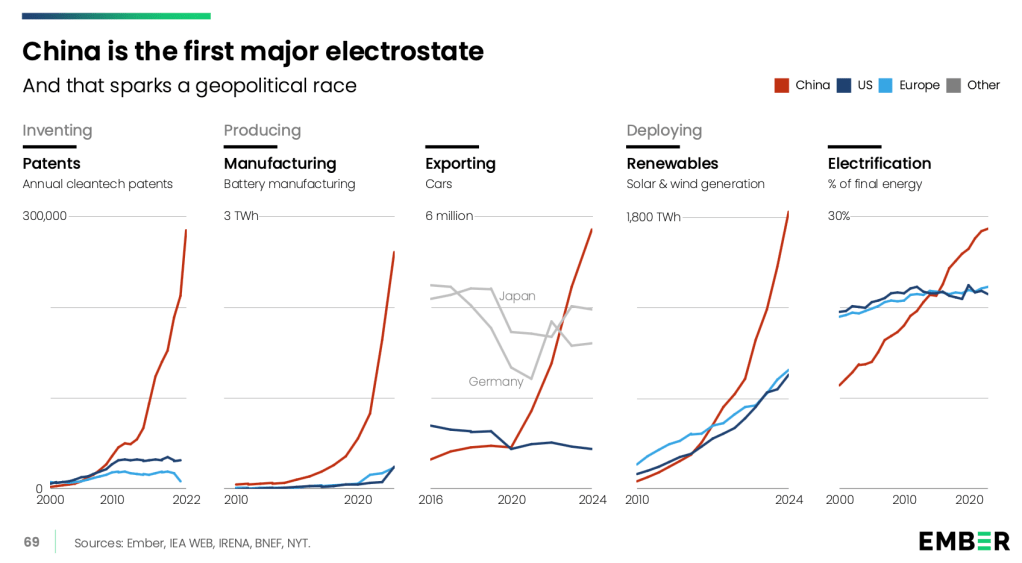
So here’s my (unofficial) contribution of two charts and two maps (why not?) that Canadian political and business leaders may wish to consider as they navigate the stormy seas of 2026 and beyond.
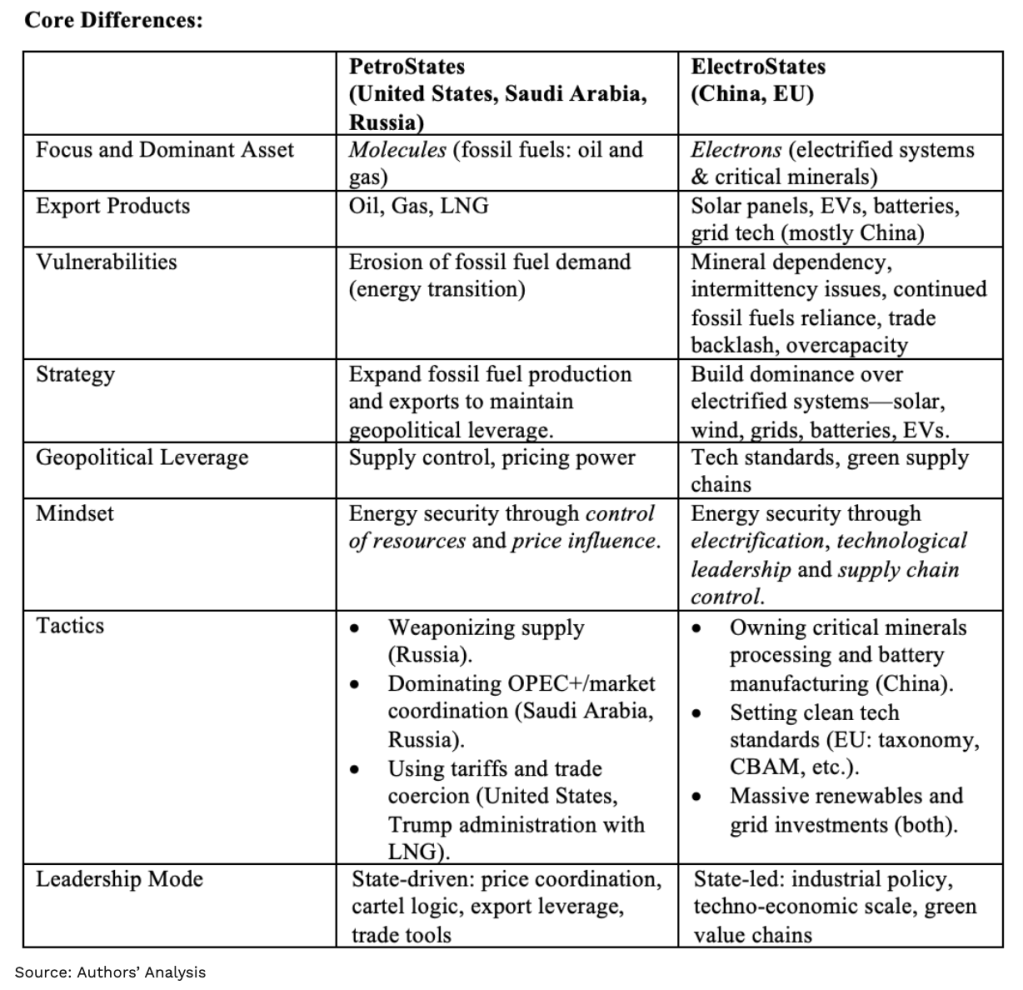
In 2025 the term “electrostate”—and China’s ascension as the world’s first electrostate—began to hit the mainstream. Put simply, an electrostate is a nation that invents, produces and deploys clean energy technologies that produce (e.g. wind and solar) and use (e.g. EVs and heat pumps) electricity, with electricity meeting a growing share of energy demand through increased electrification.
But with China as the most dominant electrostate, and the United States doubling down as a petrostate, analysts observe that “What is emerging are two competing models of energy and influence—one anchored in the enduring logic of hydrocarbons, the other in the accelerating promise of electrification. At stake is not just the future of energy systems, but the contours of geopolitical power in the decades ahead.”
And as we enter 2026 this competition between China, the most powerful electrostate, and the United States, the most powerful petrostate, was identified by the Eurasia Group as the second-biggest global risk. As they put it, “The spread of cheap electrotech is good news for the world. It enables more resilient energy systems, creates new opportunities for AI deployment, and maintains momentum for the global energy transition…China bet on electrons. The US bet on molecules. In 2026, we’ll start to see who was right.”
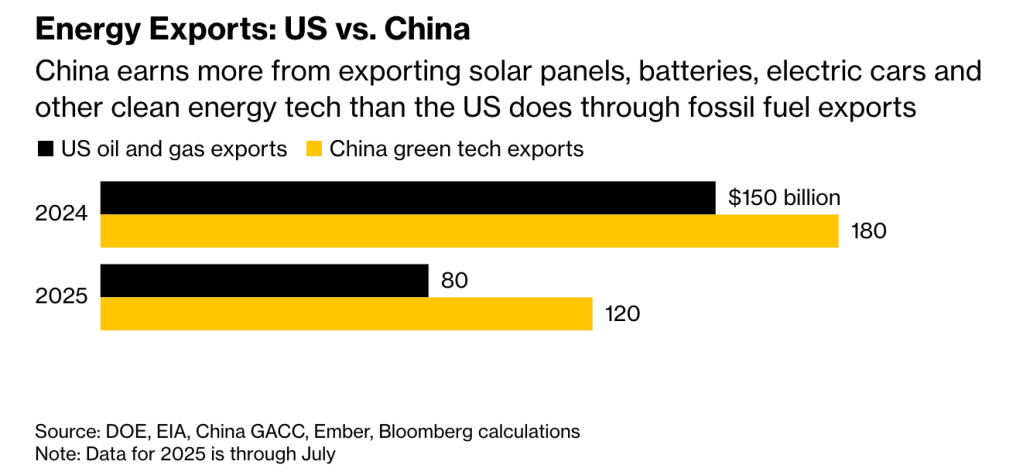
This takes us to my second chart.
The odds appear to favour the Chinese electrostate.
In the battle for energy export dominance, as Bloomberg reported (also the source of this chart) “For now, there is a clear winner: China.” While the US hit a record in oil exports in 2024 at $150 billion, China’s clean technology exports were $30 billion higher. And through the first half of 2025 this trend held, even though technology prices for solar panels and batteries had fallen sharply.
But China isn’t just exporting these technologies, they are rapidly building out production capacity in other countries. As a report from the Net Zero Industrial Lab found, “A rapid acceleration in overseas investment by Chinese green technology manufacturers is reshaping the global clean-tech landscape. Since 2022 alone, investments have surged past USD 220 billion, spanning sectors such as batteries, solar, wind, new energy vehicles (NEVs), and green hydrogen. These investments now reach 54 countries across every major region.” Hot spots of investment include Indonesia (a linchpin for nickel-rich battery-material projects and new solar lines), Morocco (cathodes and green-hydrogen for EU supply chains), Gulf states (solar module and electrolyser manufacturing backed by sovereign offtakes), and Hungary, Spain, Brazil, and Egypt (sector-specific hubs for batteries, hydrogen, or mixed clean-tech plays).
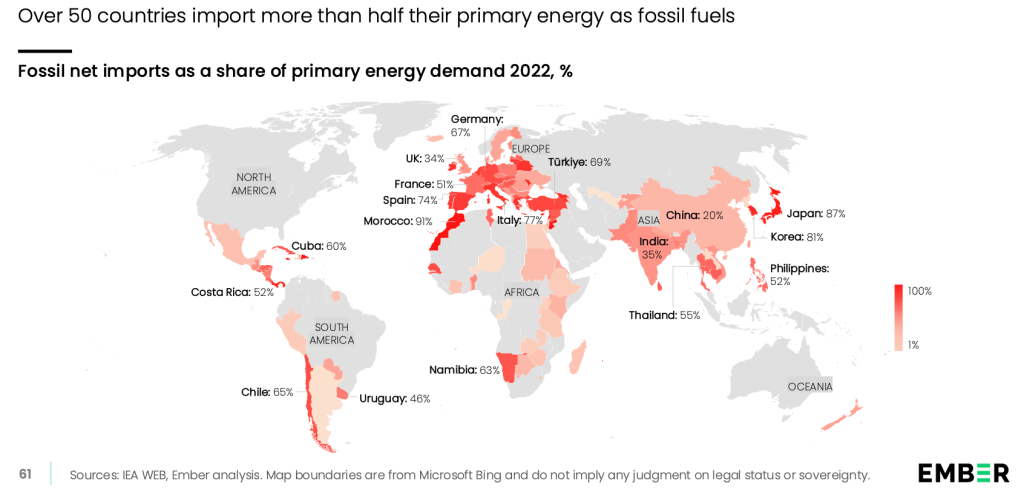
Which brings us to two important maps.
Fossil fuel import dependency is widespreadand very expensive
In Canada we are blessed with an abundance of energy of all kinds, which enables us to meet our own needs and be a significant exporter. Three-quarters of the global population reside in nations that are fossil fuel importers, and one-quarter spends over 5 percent of GDP on fossil fuel imports. The geopolitical, security, and economic risks of this dependency are myriad, from exposure to price volatility and inflation to trade deficits, vulnerability to political coercion, and compromised sovereignty. It’s not surprising, then, that import-dependent nations will jump at the opportunity to get off the fossil fuel import rollercoaster—whether by design or consumer defection (for the latter, see Pakistan).
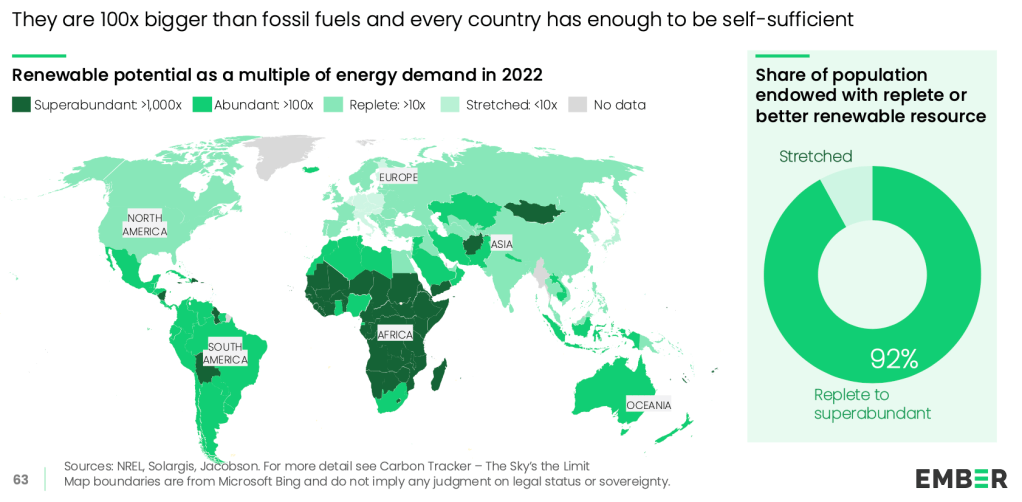
Given access to the technologies to harness it and use it, renewable power is available to all
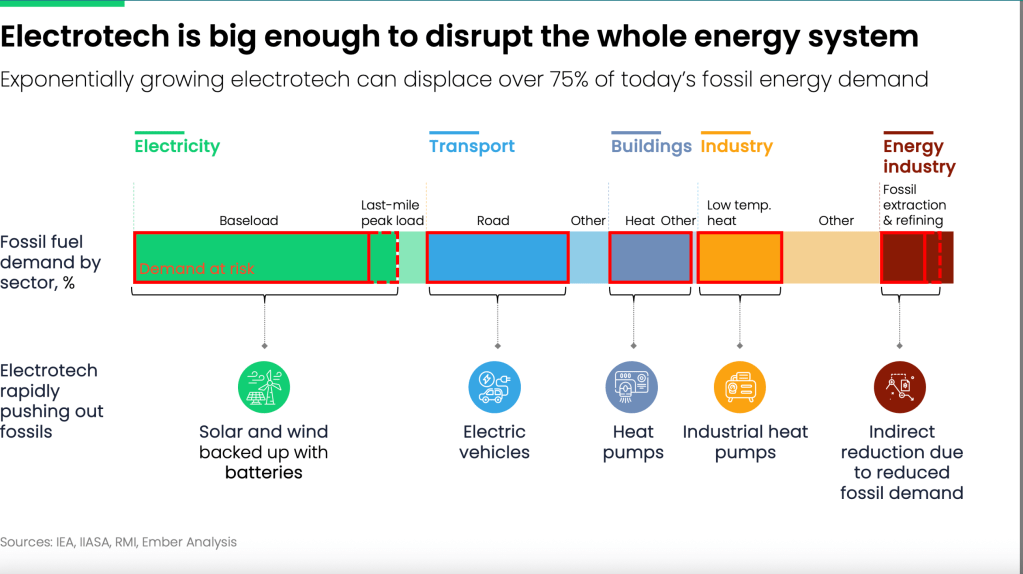
In 2025 it became evident that while much of the western discourse around the energy transition hinged on commitments to climate action, the on-the-ground reality driving investment in and adoption of electro-tech (wind, solar, batteries, EVs, heat pumps etc.) often boils down to economics and energy security. In addition to China, Latin America, Africa and South East Asia are leapfrogging past the OECD’s share of wind and solar. Brazil, Pakistan and India ranked amongst the top-5 solar PV importers from China.
As Bloomberg columnist David Fickling wrote, “There’s a comforting story that oil bulls like to tell themselves to stave off worries about the future: While the privileged few in Europe and California might have lost their minds over electric vehicles, billions of drivers in the Global South are readying themselves to provide the next wave of petroleum demand.” But according to the IEA, EV sales increased by 60% in developing countries as a whole in 2024.
Prime Minister Mark Carney believes“Canada has a tremendous opportunity to be the world’s leading energy superpower, in both clean and conventional energy.” In recent months the broad brush strokes of what this means for conventional energy—oil and gas—are becomingclearer. But what it means to be a clean energy superpower—and what it will take to grow into this—has yet to be defined.
As evidenced by the charts and maps above we had best get working on this.
Here’s a conversation that we ought to be having in Canada about our energy future (but aren’t—at least not yet): How do we show up in the energy transition—globally and at home—in the coming decades?
As a country, we have an abundance of fossil fuel resources. We also have an abundance of clean and renewable energy resources, and the critical minerals needed for the technologies that harness and capitalize on them.
We are in a relatively unique position to choose: petro-state or electro-state?
As Anne-Sophie Corbeau & Tatiana Mitrova write: “What is emerging are two competing models of energy and influence—one anchored in the enduring logic of hydrocarbons, the other in the accelerating promise of electrification. At stake is not just the future of energy systems, but the contours of geopolitical power in the decades ahead.”
The stakes, as articulated by Kingsmill BondDaan Walter & Sam Butler-Sloss, are clear: “The electrotech revolution isn’t all sunshine and opportunity—there are serious risks to falling behind. While future energy systems may no longer depend on fuel, they will depend on software, control systems, and digital infrastructure. If countries don’t develop those themselves, they’ll end up reliant on others—and vulnerable to them…We’ve entered an era defined by technological competition and energy security. By focusing on electrotech now, countries and companies can navigate the instability of the coming decade with greater resilience. And in doing so, they also lay the foundation for long-term stability, free from climate disaster.”
As I’ve previously written, “Some argue the transition to clean energy will be slow. They would prefer policymakers focus on enabling increased production and use of Canada’s oil and gas resources, citing ever-growing global demand. But increasingly, energy analysts are forecasting a future, based on current market trends, that paints a very different picture with sweeping implications for Canada….The risk to Canada, then, is that we continue to pay short shrift to the opportunities at hand—in critical minerals, batteries and other technologies, and clean and renewable electricity—in favour of trying to prop up the viability of our oil and gas sector. That we focus on the sunset, rather than the sunrise.”
This won’t be an easy conversation, but it’s a necessary one.
This piece was originally published in Business in Vancouver.
By Dan Woynillowicz & Madeleine McPherson
If you tune into the news or are active on social media, odds are you’ve seen a growing number of stories questioning whether B.C. has enough electricity and suggesting government needs to ease off on policies and programs that encourage businesses and British Columbians to electrify, switching from fossil fuels to clean electricity.
In recent months several organizations have popped up to actively push this narrative, publishing analysis aimed at raising alarm about whether B.C.’s grid is up to the challenge of substituting clean power for fossil fuels. While they claim concern about climate change, their actions and advice make their intention clear: to preserve and perpetuate the market share for oil, natural gas, and the vehicles and furnaces that burn them.
The B.C. Coalition for Affordable Dependable Energy (BCCADE)—which advocates for the continued use of natural gas—has been promoting an analysis of the implications of replacing the natural gas currently used in residential and commercial buildings with electricity. For starters, this isn’t something prescribed by any provincial or municipal policy, but even if it was their calculation—that the province would require 41,100 gigawatt hours (GWh) of additional electricity generation—is simply wrong. Regrettably, this analysis falls victim to something called the primary energy fallacy, which fails to account for the efficiency gains from electrification.
While gas furnace efficiency ranges from 80 to 90 percent, an electric heat pump is, conservatively, more than twice as efficient. Similarly, an electric hot water tank is around 30 percent more efficient than its gas equivalent. When you factor in these significant efficiency gains, total energy requirements for residential and commercial buildings drop; replacing current natural gas use would require about 20,000 GWh of additional electricity generation—just half the amount touted by BCCADE.
Which brings us to the ongoing efforts of the Energy Futures Institute, an initiative of Resource Works, to raise the alarm about whether B.C. has sufficient electricity in the near term, let alone in an electrified future. To spark public anxiety, the Institute has focused on BC Hydro’s recently increased reliance on electricity imports—precipitated by drought conditions—while mostly ignoring BC Hydro’s procurement of additional supply (which will be repeated every two years), and publishing research that overestimates future demand from electric vehicles (EVs) by at least double.
First, it’s important to acknowledge that BC Hydro is adapting to two realities: the growing impacts of climate change and growing demand for clean electricity to help tackle climate change through electrification. It’s why BC Hydro is continuously monitoring and adapting its operations as new climate science emerges, while procuring additional supply contracts every two years. BC Hydro’s current call for power received proposals for triple the amount of electricity it is seeking, with 21 proposals from independent power producers with projects in almost every region: 8 from the southern Interior, 4 from the central Interior, 5 from the north coast, 2 from the Peace Region & 2 from Vancouver Island. Wind, solar and batteries can be built quickly and technology costs have been dropping over the last decade as global production has increased exponentially: by 90 percent for solar, 70 percent for onshore wind, and more than 90 percent for batteries. Paired with the province’s flexible hydro reservoirs, B.C is well positioned to increase their role in delivering reliable, affordable clean power.
Second, B.C.’s recent reliance on electricity imports—and its longstanding electricity trade with our neighbours, whose profitability has helped keep rates low—shouldn’t be seen as a liability, but a benefit. Numerous studies have concluded that interties linking provinces and states are more reliable, resilient and affordable. For example, forthcoming research finds that more electricity trade with Alberta would reduce capital costs for new generation, reduce GHG emissions and strengthen resilience.
Fomenting the fear that B.C. doesn’t have enough power and leveraging that fear to argue the province should do less to tackle climate change does a disservice to British Columbians. It doesn’t enrich but diminishes the dialogue that we need to have in B.C. about how we produce and use energy.
British Columbians deserve less heat and more light in this discussion. Or put more simply, less fear-mongering and more facts.
Dan Woynillowicz runs Polaris Strategy and Insight, advising companies, organizations and governments on strategy and policy to navigate climate change and the transition to clean energy.
Madeleine McPherson leads a research team at the University of Victoria focused on modelling the transition to a clean energy system, and co-creating pathways with stakeholders from civil society, government, and industry.
This was originally published in Business in Vancouver.
With a provincial election looming, pollsters are trying to tease out the public mood and the issues that might dominate at the ballot box. By significant margins, the top three issues on the minds of British Columbians are cost of living (64 percent), health care (51 percent) and housing affordability (41 percent). Meanwhile, climate change and the environment has fallen from being identified as a top issue by 30 percent of British Columbians during the 2020 election to just 18 percent, according to polling by the Angus Reid Institute.
Climate change gets lumped in with “the environment,” which seems logical enough. After all, it’s caused by carbon pollution, and it impacts everything from rivers to forests and wildlife. But narrow-casting climate change as an environmental issue fails to reflect the systemic impacts already being felt by British Columbians due to climate change. In fact, the top tier issues of cost of living, health care and housing affordability are all being made worse due to climate change.
Let’s start with cost of living. Back in 2022 when gasoline prices jumped by 73 cents per litre, on average, the province’s carbon tax was an easy target for blame. But according to a recent analysis 96 percent—or 70 out of the 73 cent price increase—was driven by the global oil market. While opponents made great hay out of blaming the carbon tax for “driving up the cost of everything,” another analysis by University of Calgary economists concluded “climate policies are not a significant driver of the rising cost of living. Nor will removing policies such as carbon pricing materially improve the situation.” Highlighting the impact on grocery prices in B.C. they found that “the latest estimates from Statistics Canada suggest carbon taxes increased the average cost of food by about 0.33 per cent relative to what they would be in the absence of carbon taxes. That’s the entire effect.” That’s 33 cents on a $100 grocery bill.
Meanwhile, the Bank of Canada has noted that climate change-fuelled extreme weather “has been one factor driving up food prices in Canada.” A lot of food on Canadian grocery store shelves comes from California and Mexico, both of which have seen negative impacts on harvests due to weather. Similarly, when severe heat and drought impacts Canadian grain harvest, that drives up the price of not only a loaf of bread, but meat, too. Similarly, declining harvests of oranges and olives are driving up the cost of juice and olive oil.
Looking to point the finger for inflation? Try fossil fuels and the climate change that results from burning them.
Health, healthcare and climate change similarly collide. A recent Health Canada report explored the myriad health impacts of climate change resulting from rising temperatures and extreme heat, wildfires, and the expansion of zoonotic diseases into Canada, while also highlighting how these are not just future concerns, but impacts already being experienced today. These kinds of health impacts have a knock-on cost to Canada’s healthcare system in the billions of dollars, while also reducing economic activity by tens of billions of dollars over the coming decades.
While the linkages to climate change may not seem quite as clearcut when it comes to housing affordability, there are numerous interactions. A lack of affordable housing in cities encourages urban sprawl, forcing households into the suburbs and exurbs, which are typically underserved by public transit, meaning more driving (and the resulting fuel bills and emissions). Meanwhile, more frequent and intense extreme weather events including wildfires and atmospheric rivers—made more likely by climate change—can further strain the need to build (or rebuild) housing and infrastructure, driving up material and construction costs, while also making house insurance more limited and more expensive.
Cost of living, health care and affordable housing are all very real, very acute issues that British Columbians are experiencing directly. But it’s clear that a changing climate is making them worse, and rolling back climate action will only deepen these and other challenges. If you want solutions to issues like the cost of living, health care, housing affordability, food security or a whole host of other issues, then continued action to cut carbon pollution is a pre-requisite, not a nice-to-have.
Because climate change isn’t just another political issue, it’s an era.
Hardly a week goes by these days without a headline documenting a big new investment in the energy transition. Recently, it was Ontario’s turn, with Honda Motor Co. announcing a historic $15 billion commitment to build a comprehensive electric vehicle supply chain from start to finish.
It was another welcome proof point that Canada can compete and win as the global shift to a clean economy continues to ramp up, and evidence that our success doesn’t hinge on government subsidies alone. In fact, our relative predictability and, well, boringness, offer skittish investors safe harbour in a global sea of uncertainty.
Canada isn’t simply a go-to location for these types of big projects because of government support. In fact, Honda will receive less support for this project than it would if it were located in the U.S. Asked why it chose Canada, Honda Motor Co.’s president referenced access to critical minerals, a clean electricity supply, a strong workforce and overall confidence in the Canadian electric-vehicle ecosystem.
Beyond these tangible benefits, there is also the intangible: stability and predictability in an increasingly volatile world. As Chris Bataille, an adjunct research fellow at the Columbia University Center on Global Energy Policy, quipped, “One of the things that people keep missing about Canada is that while we’re not cheap, our rule of law and economic and political stability – i.e., our boringness – are normally second to none. That’s important in global finance, where investment risk drives everything.”
In other words, Keep Canada Boring.
The stakes are high, and the competition is fierce. Last year, investors poured nearly $2 trillion into clean-economy projects around the world. This staggering figure illustrates how markets and investors are responding to demand for materials, products and technologies made by sectors powered by clean energy and technologies.
In recent years, China, the United States, and Europe have all introduced aggressive policies and incentives in a bid to seize as much of the clean-economy prize as possible. In response, Canada has followed suit by playing to its strengths, implementing a suite of policies to build our EV market – consumer rebates, an EV supply regulation, and funding to build EV-charging infrastructure. Canada has also introduced industry incentives to supply our home market with made-in-Canada EVs, including the batteries and low-carbon steel that go into them.
These efforts are bearing fruit. Recent analysis found that Canada’s low-carbon exports have more than doubled in value over the past decade, reaching over $38 billion last year. Leading the way are exports in clean transportation, which rang in at close to $9 billion, double the value exported in 2022. This trend will undoubtedly continue, considering that Canada has now attracted a cumulative total of more than $46 billion invested in the EV assembly and battery supply chain since 2020. More production and more exports mean more jobs and prosperity for Canadians.
But, as recently reported in the New York Times, as political power has swung between the Democrats and Republicans, environmental rules have been subject to “a cycle of erase-and-replace whiplash.” Economists warn that the uncertainty this brings to business is far worse than the regulations themselves. As Marty Durbin, senior vice president for policy at the U.S. Chamber of Commerce, put it, “If the regulatory changes are just whiplash or snapback, it creates a level of uncertainty that makes it very hard to build a vibrant economy.”
Recognizing the degree to which government regulations, policies and programs have been fundamental in establishing Canada’s attractiveness as an investment destination, there’s a very real risk to securing additional projects if these were to disappear or radically change. Preserving our advantage requires that Canada doesn’t succumb to the wild policy pendulum swings that have become the norm south of the border.
No matter the partisan stripe, any government in Canada – federal or provincial – can and should recognize that we have what it takes to be competitive as markets re-orient towards net zero: a clean and growing electricity grid, an abundance of the metals and minerals the world needs, strong trade relationships providing access to global markets, robust regulatory frameworks, the innovative and entrepreneurial mindset of Canadians, and Indigenous economic reconciliation in action.
Leveraging these advantages, and coupling them with policy stability and certainty in a world where these are increasingly rare commodities, can ensure a resilient, prosperous economy for all.
So, in the spirit of short, snappy slogans: Keep Canada Boring to Keep Canada Competitive.
The following essay was originally published as part of Policy magazine’s Road to 2025 series.
“Every election is a climate election.”
Far from being just a slogan, this refrain reflects the reality that society’s reckoning with climate change is destined to span not just successive election cycles, but multiple decades. Still, political and policy leadership will continue to dictate the level of effort (or lack thereof) made to pivot away from burning fossil fuels, aggressively reduce carbon pollution, and avert the worst possible outcomes of climate change.
But what if we consider climate change as not just another election issue, but as one that cuts across all other issues? What if, as futurist Alex Steffen does, we acknowledged that “Climate change is not an issue but an era”?
To compartmentalize climate change as an environmental issue misrepresents the scope and scale of how it is already impacting — and will increasingly impact — most facets of our human existence. Indeed, in some cases, the very solutions that will help us combat climate change can also serve to address or alleviate other issues.
But beyond the next election outcome’s implications for these efforts, there’s also a question about the role that climate change might have in shaping the outcome itself. Currently, pundit prognostication suggests that climate change, as an issue, won’t have much bearing on the next federal election. Recent public opinion research backstops this view.
Polling by Abacus Data exploring the top three most important issues facing Canada today found the rising cost of living as the most cited, identified by 72% of respondents. Housing affordability and accessibility (50%), healthcare (45%) and the economy (35%) followed. Tied for fifth were climate change and the economy, and immigration, identified by 23% of respondents.
Figure 1: Abacus Data poll findings – What are the 3 most important issues facing Canada today?
Carbon tax, cost of living and the transition to clean energy
Let’s start with the rising cost of living, given how dominant it is as an issue of public concern.
While opponents of the carbon tax have made great hay out of blaming it for increasing the price of everything, analysis by University of Calgary economists Trevor Tombe and Jennifer Winter lays this claim to rest. “While concern around affordability is clearly warranted,” they write, “climate policies are not a significant driver of the rising cost of living. Nor will removing policies such as carbon pricing materially improve the situation.” Highlighting the impact on grocery prices in BC, as an example, Tombe and Winter find that “the latest estimates from Statistics Canada suggest carbon taxes increased the average cost of food by about 0.33% relative to what it would be in the absence of carbon taxes. That’s the entire effect.” That’s 33 cents on a $100 grocery bill. Not nothing, but not the smoking gun carbon tax detractors would have people believe.
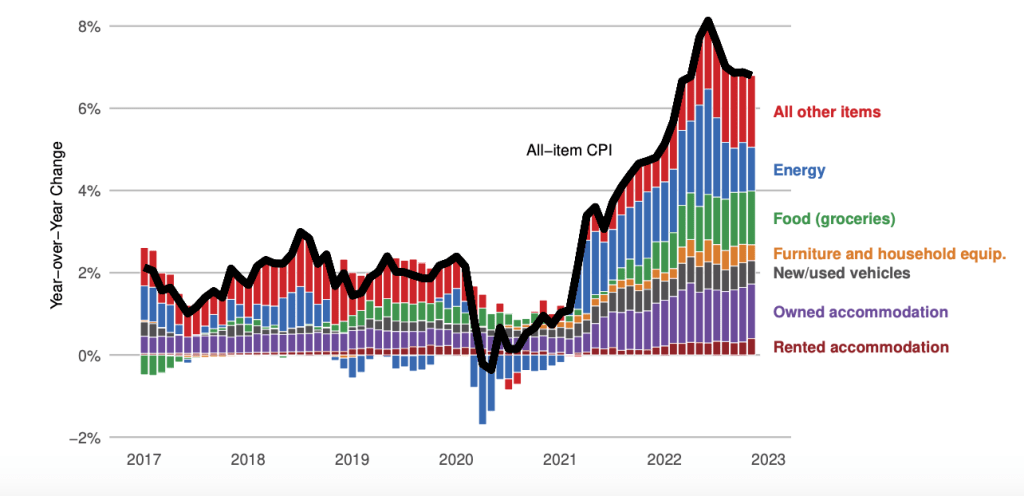
If governments are going to tackle affordability, they need to focus on the things that are actually making life less affordable. Exploring the drivers of post-pandemic inflation in Canada through its peak in 2022, Dr. Tombe and another University of Calgary colleague, Yu Chen, found (Figure 2) that when Canadian inflation peaked at 8.1% in June 2022, higher energy prices were responsible for nearly one-third of inflation, at 2.6% points (with 1.9% points from gasoline alone). Those energy costs, of course, were shaped by global prices for oil and natural gas, both of which were rising thanks to a robust post-pandemic economic recovery and lagging oil production in key OPEC countries before being turbocharged by Russia’s invasion of Ukraine.
Figure 2: Key Drivers of Consumer Price Inflation in Canada, Jan 2017 to Nov 2022
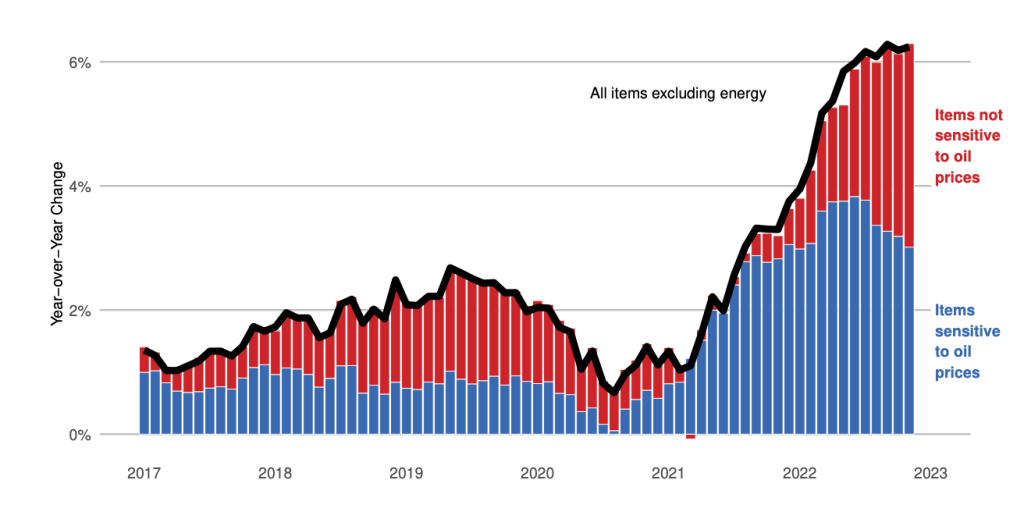
They also looked beyond the direct effect of energy prices to estimate spillover effects, noting that “Energy, after all, is an important input in the production of many goods and services throughout the economy. Products that are transportation intensive or that require heating or cooling — food, for example, satisfies both these conditions — may be particularly sensitive to energy price increases.” Here again, the findings are significant: items sensitive to oil prices accounted for nearly 60% of Canada’s non-energy inflation in July 2022, and over 85% of the increase since February 2020 (Figure 3).
Figure 3: Contribution of Items Sensitive to Oil Prices to Non-Energy CPI Inflation
In sum: “High energy prices, and the resulting production-cost increases for many other goods and services throughout the economy, may largely explain Canada’s accelerating inflation.”
This shines a spotlight on a key benefit of the transition from fossil fuels to clean energy —escaping the volatility and price spikes that bedevil global oil and natural gas prices. As researchers from the Roosevelt Institute have noted, based on their research, it’s clear that transitioning from fossil fuels towards renewables can help stabilize energy prices for two reasons: “First, renewable energy will bring the majority of energy consumption into the electricity sector, a highly regulated sector that has historically produced stable energy prices. Second, renewables prices are inherently stable compared with fossil fuels.”
While critical mineral inputs and supply chain snags can affect the capital cost of wind turbines or solar photovoltaic (PV) panels, the reality is once these technologies are installed the cost is fixed. Unlike a coal or gas plant, their fuel — the wind and sun — is free. And the more we plug into a clean power grid — to fuel electric vehicles and meet heating and cooling needs with heat pumps — the more we can reduce reliance on oil and gas and minimize exposure to their price fluctuations. As an Oxford study concluded, “Compared to continuing with a fossil fuel-based system, a rapid green energy transition will likely result in overall net savings of many trillions of dollars — even without accounting for climate damages or co-benefits of climate policy.”
Climate considerations in housing affordability and health care
What about housing affordability and climate change? While the linkages to climate change may not seem quite as clearcut, there are numerous intersections and how policymakers tackle this issue has the potential to increase, lock-in, or reduce carbon pollution and homeowner costs.
A lack of affordable housing in cities encourages urban sprawl, forcing households into the suburbs and exurbs, which are typically underserved by public transit, meaning more driving (and the resulting fuel bills and emissions). Meanwhile, more frequent and intense extreme weather events — made more likely by climate change — can further fuel the need to build (or rebuild) housing, driving up costs, while also making house insurance more limited and more expensive.
As the Affordability Action Council has noted, “Every residential building that is built between now and 2050 without the net-zero target in mind will create a liability down the line that someone will have to pay for. While retrofits generate multiple benefits, it is much cheaper to build new housing that meets a net-zero standard than it is to retrofit buildings.” Which is why they recommend a multi-faceted approach to new housing that focuses on affordability as well as convenience, resilience and energy efficiency, with energy costs and net-zero climate goals in mind.
While some politicians may position climate action and housing affordability as a trade-off, polling by Abacus Data found that 62% of Canadians believe that it is important to address the housing affordability issue without compromising Canada’s climate goals. Similarly, 78% believe it’s important to build housing in ways that minimize pollution contributing to climate change, and 84% believe it’s important to develop new housing in a manner that is resilient to climate change impacts. The linkages between climate change and housing affordability are clear, as are Canadians’ expectations.
Health, health care and climate change similarly overlap. A recent Health Canada report explored — in great detail — the myriad health impacts of climate change resulting from rising temperatures and extreme heat, wildfires, and the expansion of zoonotic diseases into Canada, while also highlighting how these are not just future concerns, but impacts already being experienced today. As a resident of BC, I am still struck by the impacts of the climate change-fuelled heat dome and catastrophic flooding in the province in 2021, in which 600 people lost their lives and many more suffered.
The Canadian Climate Institute has similarly documented how the health impacts of climate change will have a knock-on cost to Canada’s health care system in the billions of dollars, while also reducing economic activity by tens of billions of dollars over the coming decades.
Clearly, measures that make our communities more resilient to a changing climate —whether that be to extreme weather, fire or floods — and that reduce air pollution will help address the health impacts on Canadians and costs to our already-struggling health care system.
It’s the economy, stupid
Last, but certainly not least, is the economy. While there is still considerable attention paid to the potential economic implications for Canada’s oil and gas sector from aggressive climate action, global markets are quickly re-orienting towards the economic opportunities of the energy transition. What if that’s the lens through which federal parties’ economic platforms are considered in the next election?
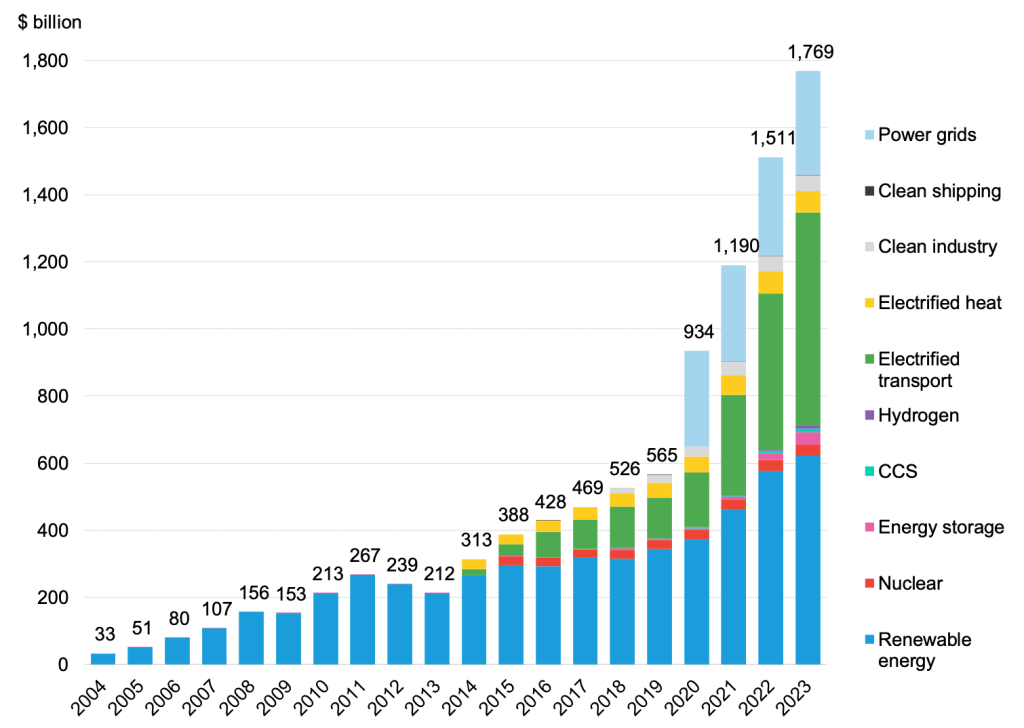
According to BloombergNEF, 2023 saw record-breaking investment in the energy transition (Figure 4). Nearly US$1.8 trillion of capital flowed into the global clean energy transition, up 17% relative to 2022 and more than three times more than in 2019. In Canada, the installed capacity of wind, solar and energy storage grew by 11.2% in 2023, reaching a new total of 21.9 GW, according to data compiled by the Canadian Renewable Energy Association. Perhaps ironically, 92% of that growth occurred in Alberta, as the provincial government’s moratorium on renewable energy approvals didn’t impact already-approved projects from coming online.
Figure 4: Global investment in energy transition, by sector
Note:Start years differ by sector but all sectors are present from 2020 onwards. Most notably, nuclear figures start in 2015 and power grids in 2020. CCS refers to carbon capture and storage.
But the energy transition sector that has featured most significantly in Canada is electrified transport and the battery supply chain. Over the past couple of years hardly a month has gone by without a significant investment in Canada’s battery and electric vehicle manufacturing and supply chain — including Volkswagen, Stellantis, Ford, General Motors, Umicore, LG Energy Solutions, Posco Future M Co Ltd and more. It’s notable that almost all of these investment decisions referenced Canada’s clean electricity supply as a key factor in their decision to invest here.
An analysis by the Future of Canada’s Automotive Labourforce (FOCAL) initiative found that in a scenario with widespread consumer acceptance of EVs and continued efforts to secure additional EV production mandates, Canada’s automotive manufacturing industry would see a significant increase in its assembly capacity to over 1.7 million vehicles by 2040. With growth in the battery supply chain — and critical mineral production and processing to supply it — the analysis found that that more jobs would be created in assembly, battery production, and mining than would be lost in internal combustion engine and powertrain production, with a net economic gain over $50 billion and close to 100,000 jobs created.
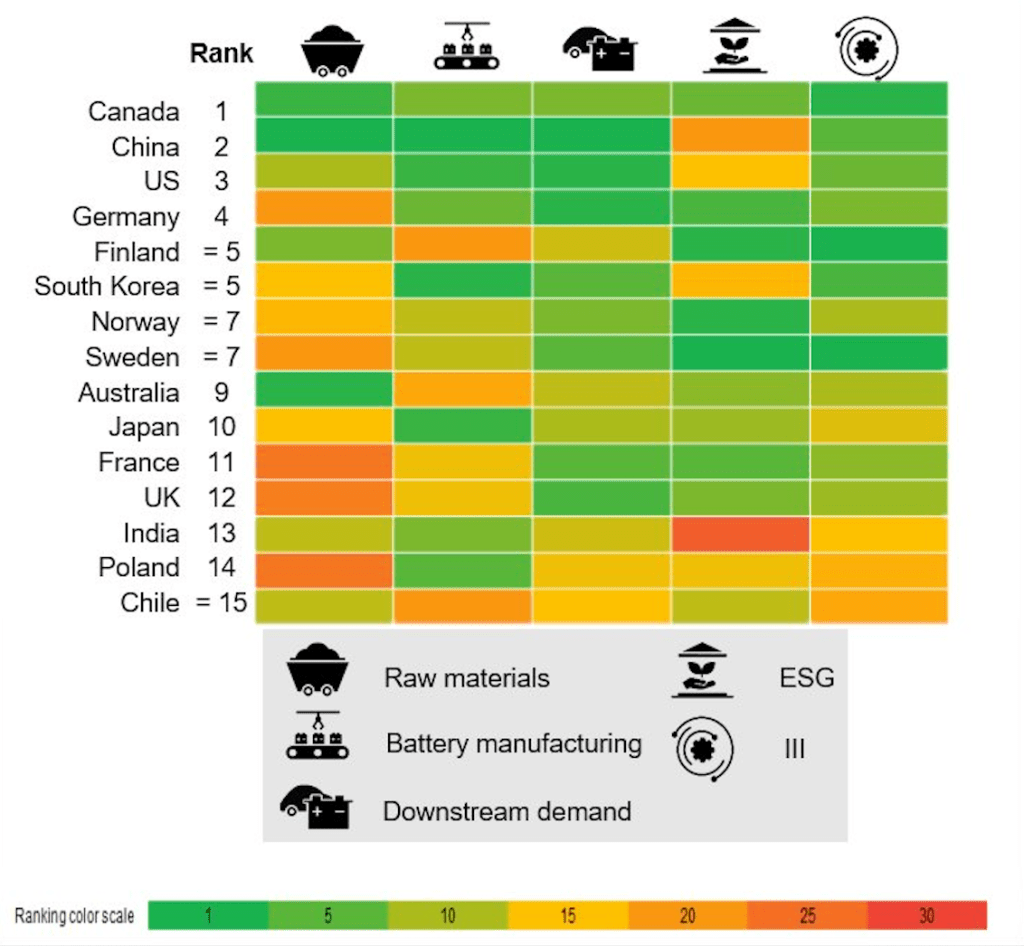
The success to date in attracting investments is the result of federal, provincial and municipal collaboration. Together, their efforts have led to Canada leapfrogging China to secure the top spot in BloombergNEF’s global lithium-ion battery supply chain ranking, which looks at each country’s potential to build a secure, reliable and sustainable supply chain for lithium-ion batteries . According to BloombergNEF, Canada’s consistent manufacturing and production advances, strong ESG credentials, policy commitment at both the provincial and federal level and integration with the US automotive sector (which is benefiting from the US Inflation Reduction Act), have helped us become a leader in forming the battery supply chains of the future (Figure 5).
Figure 5: BloombergNEF’s global lithium-ion battery supply chain ranking
This success didn’t happen by accident, nor is future success assured. Durable government policy (and not just dollars) is critical, a message that leaders of all political parties, federal and provincial, need to consider. As BloombergNEF noted, “The rankings reflect only developments in 2023, and that actions by other countries in this competitive market – or future inaction on the part of Canada – could result in upsets in the years ahead. Across all the metrics, it’s a race where in a year where you decided to do nothing, other people bypass you.””
As I’ve previously said, “The risk to Canada, then, is that we continue to pay short shrift to the opportunities at hand—in critical minerals, batteries and other technologies, and clean and renewable electricity — in favour of trying to prop up the viability of our oil and gas sector. That we focus on the sunset, rather than the sunrise.”
The stakes in the next federal
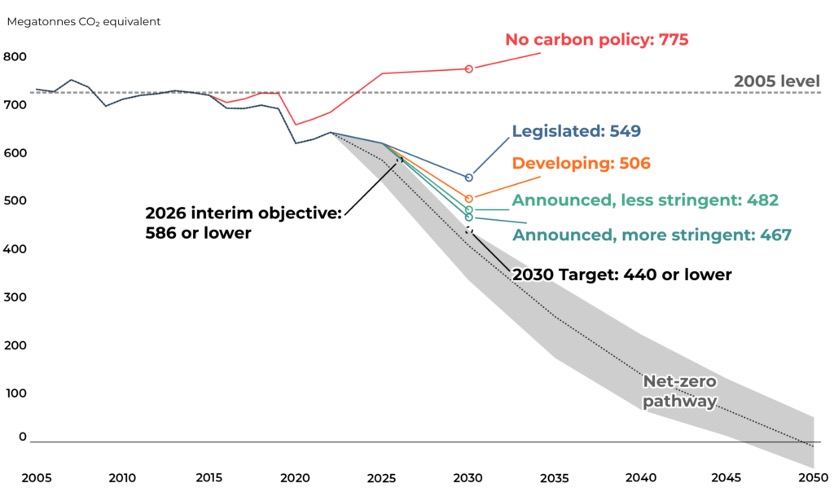
Canadians deserve political discourse grounded in the reality that it is neither too late or too futile to act, but that we are not progressing quickly enough. While it’s easy to be cynical about efforts to date, especially as the direct impacts of climate change arrive at our doorstep with greater frequency and ferocity, analysis of the federal government’s 2030 Emissions Reduction Plan by the independent Canadian Climate Institute (Figure 6) concluded that current and proposed policies can deliver 85 to 90 per cent of Canada’s 2030 target.
Figure 6: Canadian Climate Institute modeling of Canada’s emissions pathway
In fact, the whole world has made significant strides forward. As David Wallace-Wells has documented, “Thanks to astonishing declines in the price of renewables, a truly global political mobilization, a clearer picture of the energy future and serious policy focus from world leaders, we have cut expected warming almost in half in just five years.”
This isn’t to suggest we are making progress quickly enough, or even that the success of current policies and approaches is guaranteed. If we are to lock-in progress to date and build on it, it’s clear that we will need ongoing and enhanced policy leadership. With the 2020s unfolding as the “decisive decade” for climate action the bottom line is quite simple:
Policy matters. Politics matters. And every election matters.
In Canada, the 2015, 2019 and 2021 federal elections were all — in hindsight if not evidently at the time — climate elections. In both the 2019 and 2021 elections, climate change was the top election issue, according to polling by Angus Reid.
Floods, wildfires, hurricanes and other extreme weather events to come may yet bump climate change, as an issue, up voters’ priority list. But as documented above, efforts to avoid the worst outcomes of a changing climate aren’t just about the environment. The impacts of climate change cut across top of mind issues from affordability, to housing and healthcare, as do the solutions.
While some politicians might prefer a “carbon tax election,” for obvious reasons, such a narrow consideration of climate change would do a disservice to Canadians. Whether affordability, housing or health care are their ballot box concern, the spectre of a changing climate — and how we confront the challenges and seize the opportunities of that change — needs to be discussed and debated.
It’s time for federal politicians — of all political stripes — to approach climate change for what it is: not an issue, but an era.
Contributing Writer Dan Woynillowicz is the Principal of Polaris Strategy + Insight, a public policy consulting firm focused on climate change and the energy transition.
My comments today centre on the need to ensure that policymaking is grounded in credible analysis, and an understanding that successfully navigating this transition requires that we keep our eyes on the road ahead, not fixed on the rear-view mirror.
Some argue the transition to clean energy will be slow. They would prefer policymakers focus on enabling increased production and use of Canada’s oil and gas resources, citing ever-growing global demand. But increasingly, energy analysts are forecasting a future, based on current market trends, that paints a very different picture with sweeping implications for Canada.
I’d like to draw your attention to a forecast released last week by DNV, global experts in assurance and risk management. As they put it, “Unlike most energy forecasters, DNV does not develop scenarios…our analysis produces a single ‘best-estimate’ forecast of the energy future.”
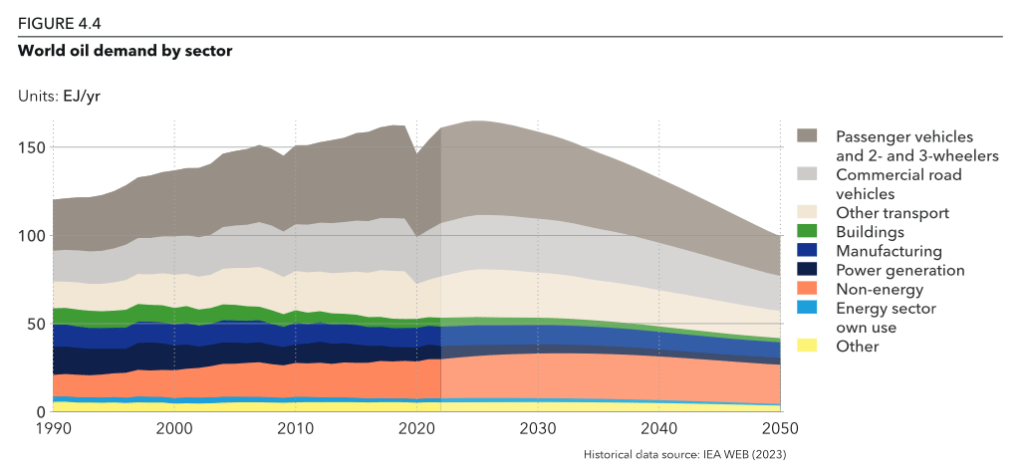
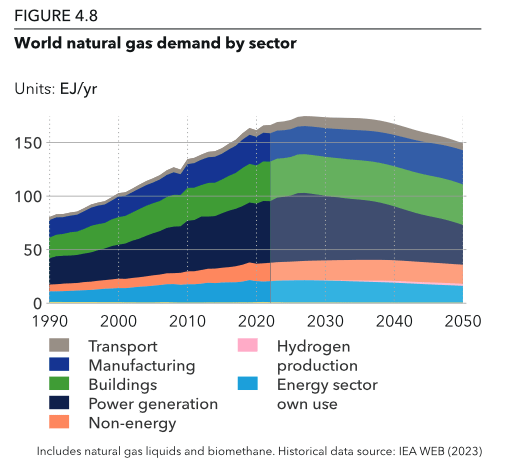
In this ‘best-estimate’ forecast they foresee that coal, oil, and gas will each begin an inescapable decline before the end of this decade. Particularly material for Canada are the implications for oil and gas. Oil demand tips from growth to decline in 2027 as electrification of road transport accelerates. Global demand for gas also peaks in 2027, plateaus for a decade and then declines.
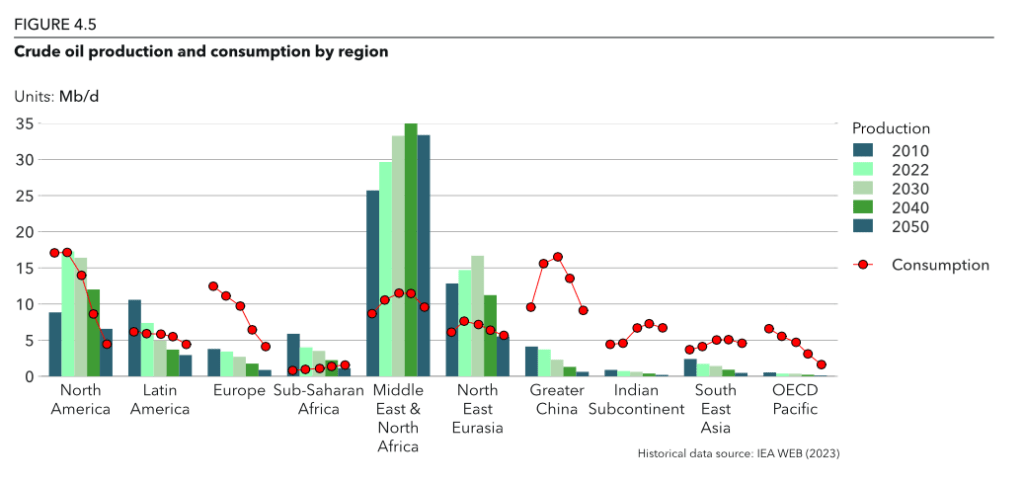
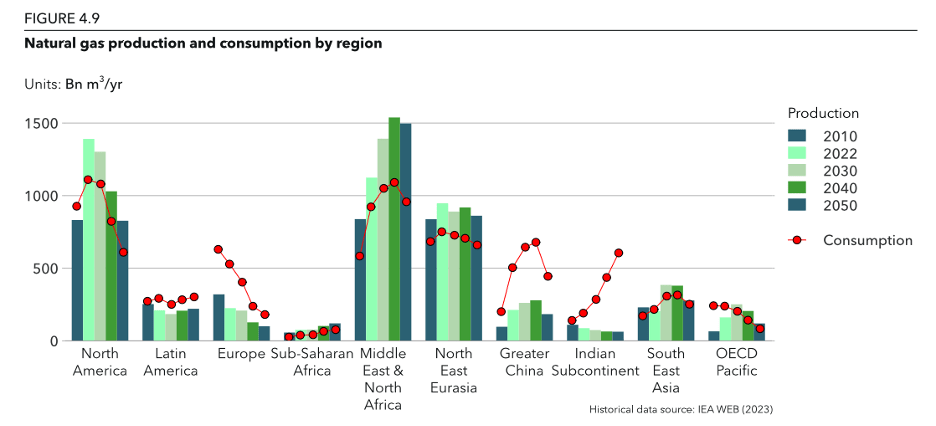
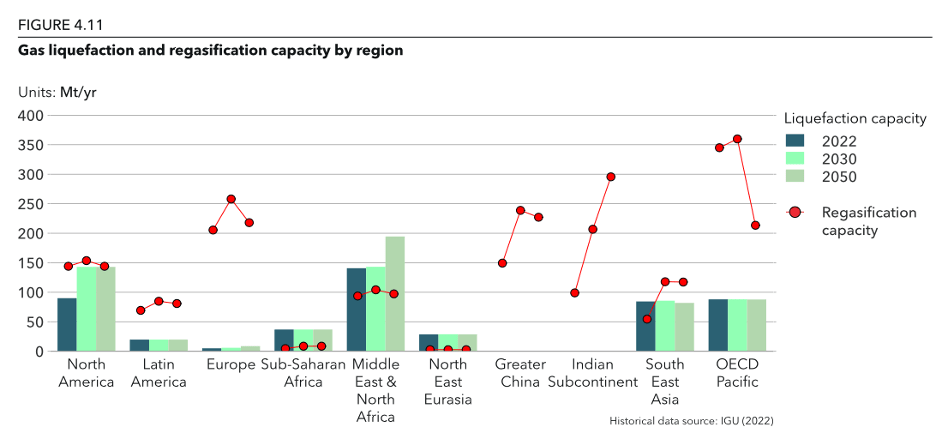
But it is their forecast for North American oil and gas production that is particularly noteworthy, and in stark contrast to what you might hear about on the news or as members of this committee. North American oil is foreseen plateauing at around 17 million barrels per day until 2024, then declining to 7 million barrels per day in 2050. North American gas production peaks in the 2020s and declines to 2030 and beyond. Liquefaction capacity to produce LNG in North America is forecast to peak in 2030 and plateau. These declines are faster and steeper in net zero scenarios—in which the world succeeds in limiting warming to 1.5 degrees Celsius—whether produced by DNV, the International Energy Agency, or even Shell and BP.
A passage of dialogue from Ernest Hemingway’s 1926 novel, The Sun Also Rises seems particularly relevant to this future:
“How did you go bankrupt?” Bill asked.
“Two ways,” Mike said. “Gradually, and then suddenly.”
The flip side of this is the extent to which deployment of clean energy is and will continue to accelerate. The key technologies for achieving net zero— solar, wind, batteries, heat pumps and green hydrogen—are not and will not grow on a linear basis, but are following an S-shaped, exponential curve driven by self-reinforcing feedback loops that accelerate their cost reductions and scaling.
The risk to Canada, then, is that we continue to pay short shrift to the opportunities at hand—in critical minerals, batteries and other technologies, and clean and renewable electricity—in favour of trying to prop up the viability of our oil and gas sector. That we focus on the sunset, rather than the sunrise.
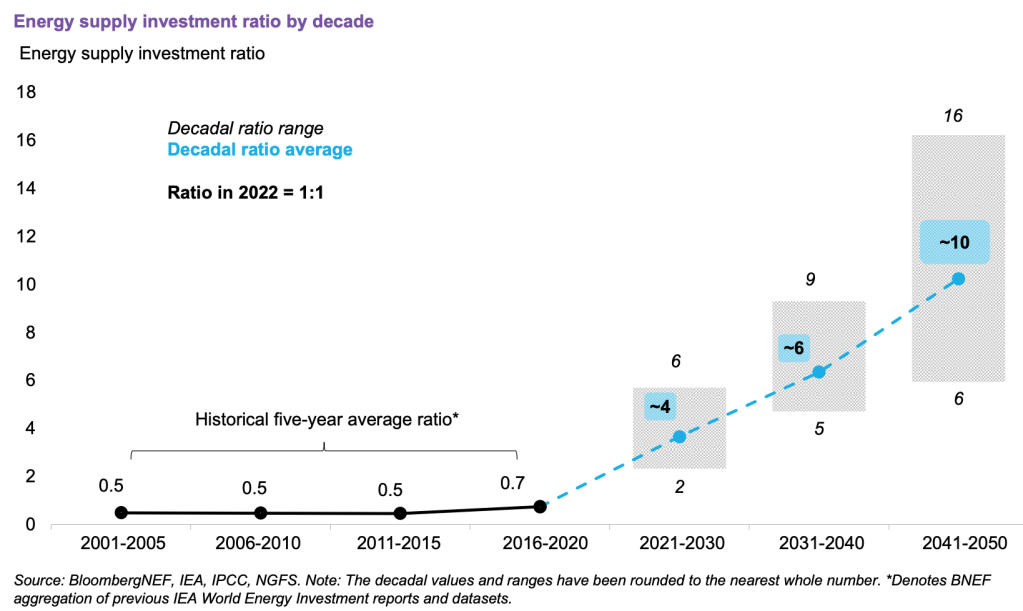
There is a very real opportunity cost when it comes to the efforts of policymakers and the spending of public dollars, neither of which are limitless. To achieve net-zero we need to target public policy and spending to help shift capital from fossil fuel to clean energy investment at a ratio of $4 invested in clean energy for every $1 invested in fossil fuels in this decade.
The key takeaways for the committee to consider are:
First, that we need to prepare for a net-zero future in which the oil and gas sector will not be growing and proactively manage the implications—to communities, workers, and government revenue—while ensuring the sector responsibly reduces its emissions and manages its environmental liabilities.
And third, that we don’t attempt or aspire to simply mirror the IRA and our American neighbours, but surgically select those sectors and opportunities in which Canada can compete and win throughout the energy transition.
The summer of 2023 is, according to scientists, what climate change looks like. Heatwaves that test the limits of human survival. Wildfires and floods whose damage isn’t just measured in dollars, but lives and livelihoods lost. Droughts that jeopardize food production. These climate change-fuelled extreme weather events weren’t isolated to a few countries or continents this year but were ubiquitous. Whether at home or on holiday, more and more of us were directly experiencing the consequences of climate change.
We have entered a new era in which the impacts of climate change aren’t some distant threat, but a lived experience—an experience that will catastrophically intensify absent greater effort to cut carbon pollution and pivot away from fossil fuels. And so, in our current era, every election is a climate election.
What’s at stake in the U.S election?
It’s far from hyperbole to say that President Joe Biden’s efforts to scale up the United States’ fight against climate change have been a game changer. And whether to build on these efforts or tear them down is very clearly on the ballot.
The Inflation Reduction Act (IRA), passed in the summer of 2022 without a single Republican vote, is expected to deliver at least US$369 billion in support for climate and clean energy solutions over the next decade. Goldman Sachs believes that figure will be much higher, as much as US$1.2 trillion.
Just one year in, the results of the IRA are impressive. According to data compiledby the American Clean Power Association, by August 2023 federal support from the IRA had spurred the announcement of US$271 billion of private investment in domestic clean energy projects and manufacturing facilities—more than the combined clean energy investments of the previous eight years. Together, these investments are projected to deliver 185 gigawatts (GW) of of new utility-scale clean energy capacity (to put this in context, Canada’s entire electricity capacity is 154GW), US$4.5 billion in consumer savings, 29,780 new manufacturing jobs, and more than US$22 billion in manufacturing investment in 83 new or expanded utility-scale clean energy manufacturing facilities. A similar acceleration and scaling up of investment in electric vehicle (EV) manufacturing, battery production, hydrogen and carbon capture and storage (CCS) is also occurring. As Jesse Jenkins, a Princeton professor who has been leading analysis of the IRA, says, “It seems like every week there’s a new factory facility somewhere.”
While the domestic impacts of the IRA are impressive enough on their own, they’ve gone well beyond American borders. For example, the European Union — seeing the IRA for what it is, not just environmental policy but strategic industrial policy —responded with its Green Deal Industrial Plan, aimed at enhancing the competitiveness of its net-zero industry and accelerating its transition to net zero. Here in Canada, the federal government responded with $80 billion worth of new measures to spur low-carbon innovation and deployment, aiming to build on its climate policy framework with targeted support for clean electricity, clean-tech manufacturing (especially in battery production and its supply chain), hydrogen and CCS. Other nations — including China, Japan and South Korea — are making similar moves.
As the head of the International Energy Agency (IEA), Fatih Birol, put it: “I want to make it clear: the Inflation Reduction Act is the single most important climate action since the Paris Agreement in 2015.” But will the US stay in the race to net zero or pull up lame? That depends on 2024.
Shaping the climate ballot question
For President Biden and the Democrats, the IRA isn’t just about fighting climate change. It’s about reviving the Rust Belt, bringing manufacturing jobs back to American soil and spurring new innovation and industries that will not only deploy clean technologies at home, but which can be sold to the world. In Biden’s own words, “When I hear ‘climate’, I think jobs. Good-paying, high-quality jobs that will help speed our transition to a green economy of the future and unleash sustainable growth.”
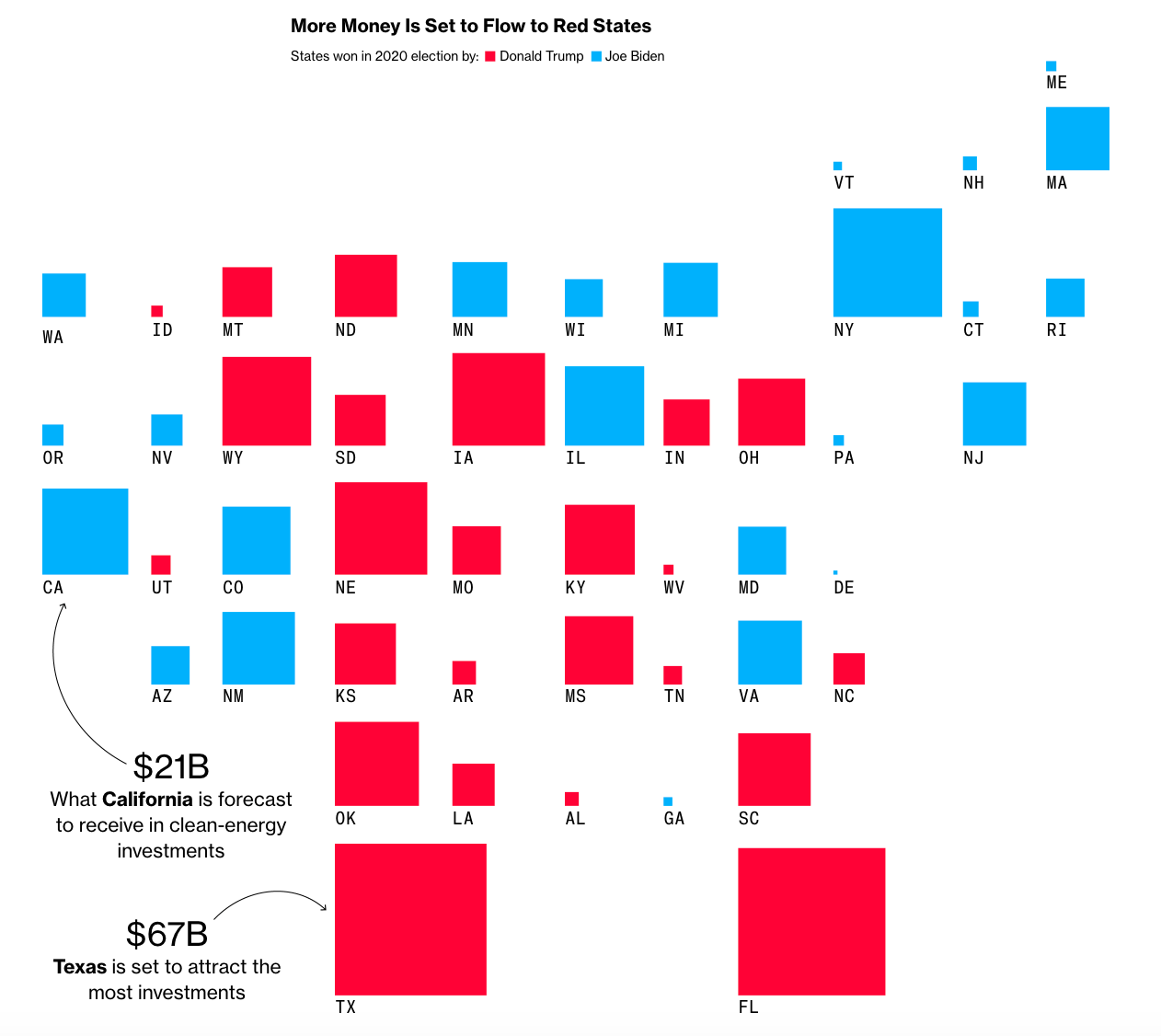
It just so happens that most of the IRA-induced investment — and the jobs that come with it — will occur in red states (Figure 1). According to Bloomberg, the White House estimates that red states will attract US$337 billion in investments for large solar, wind and storage projects through 2030, compared toUS$183 billion into blue states. But this isn’t vote-buying by a Democratic President, it’s a function of where the nation’s best wind and solar resources are. Some analystssuggest, optimistically, that we’ve seen Republicans soften their opposition to climate change and that, over time, we could see a fading of their default support for fossil fuels and default opposition to renewables as a result of the IRA.
Clearly, the Democrats want “climate jobs” not “climate change” to be a ballot question.
Figure 1: More IRA Money Is Set to Flow to Red States (Bloomberg)
While it’s possible voters in these red states might come around in their support for the IRA — driven by the economic benefits more so than the climate benefits — it’s clear that the Republican establishment has no such inclination.
Leading Republican presidential primary contender and former President Donald Trump has said he would end “Green New Deal atrocities” on his first day. Similarly, Governor Ron DeSantis of Florida has said he wants to “rip up Joe Biden’s Green New Deal.” On Capitol Hill, Republican lawmakers have been using everyopportunity to try to kneecap or rescind the clean energy components of the IRA.
Conservative think tanks — led by the Heritage Foundation — have laid out a planto dismantle President Biden’s climate efforts as part of Project 2025, a “battle plan” for the first 180 days of a Republican administration that would see the IRA repealed alongside the shredding of “regulations to curb greenhouse gas pollution from cars, oil and gas wells and power plants, dismantling almost every clean energy program in the federal government and boosting the production of fossil fuels.” The plan has been delivered to every Republican presidential hopeful.
The Republicans want fighting “green woke-ism” — and the “woke agenda” more broadly — to be the ballot question.
Campaign crystal ball
In June, a poll of Americans found that 24 percent had been personally impacted by an extreme weather event in the past 12 months. By August, 62 percent thought that climate change was currently having some or a great deal of impact on their local community.
It seems likely that between now and election day, Americans will continue to experience the impacts of climate change and, increasingly, see the benefits of clean energy investments spurred on by the Biden administration. But what issue will emerge as the ballot question and whether any of this will matter come election day is hardly worth speculating over (Events, dear boy, events!).
But it is worth considering the implications of a Biden versus Republican (whether Trump or DeSantis) presidency in 2025.
A second term for President Biden would see the US stay the course, and almost certainly introduce additional measures and efforts to ramp up climate action, cut pollution, and position the United States to compete in a net zero future. In contrast, a Republican presidency would almost certainly spell the end of any federal climate efforts.
But as witnessed under President Trump, promising to “make coal great again” and doing so are very different things. Thanks to state-led efforts and falling wind and solar power costs, renewable energy investments in the US continued throughout his presidency. Meanwhile, seven major U.S. coal companies claimed bankruptcy and 50 coal-fired power plants closed. The market forces blowing in this direction have only strengthened. Analysts at Bloomberg New Energy Finance say that the clean energy transition is now hard-wired into the US economy. While progress would almost certainly slow, it cannot be reversed.
As for what this means for Canada, it depends very much on the priorities of the prime minister of the day: seize every opportunity to do more, or less, in the race to net zero? In that sense, Canada’s next election will be just as consequential as the US election, because now, every election is a climate election.
This essay was originally published in Policy magazine.



 Polaris Strategy + Insight