This post was originally published in Business in Vancouver with co-author Mark Zacharias.
Premier David Eby wants B.C. to be a clean energy superpower. Minister of Energy and Climate Solutions Adrian Dix wants the province to be more like Norway, exporting more conventional energy while using more clean electricity at home. Both point to clean electricity as the backbone of faster economic growth, as envisioned in the province’s Look West Economic Strategy.
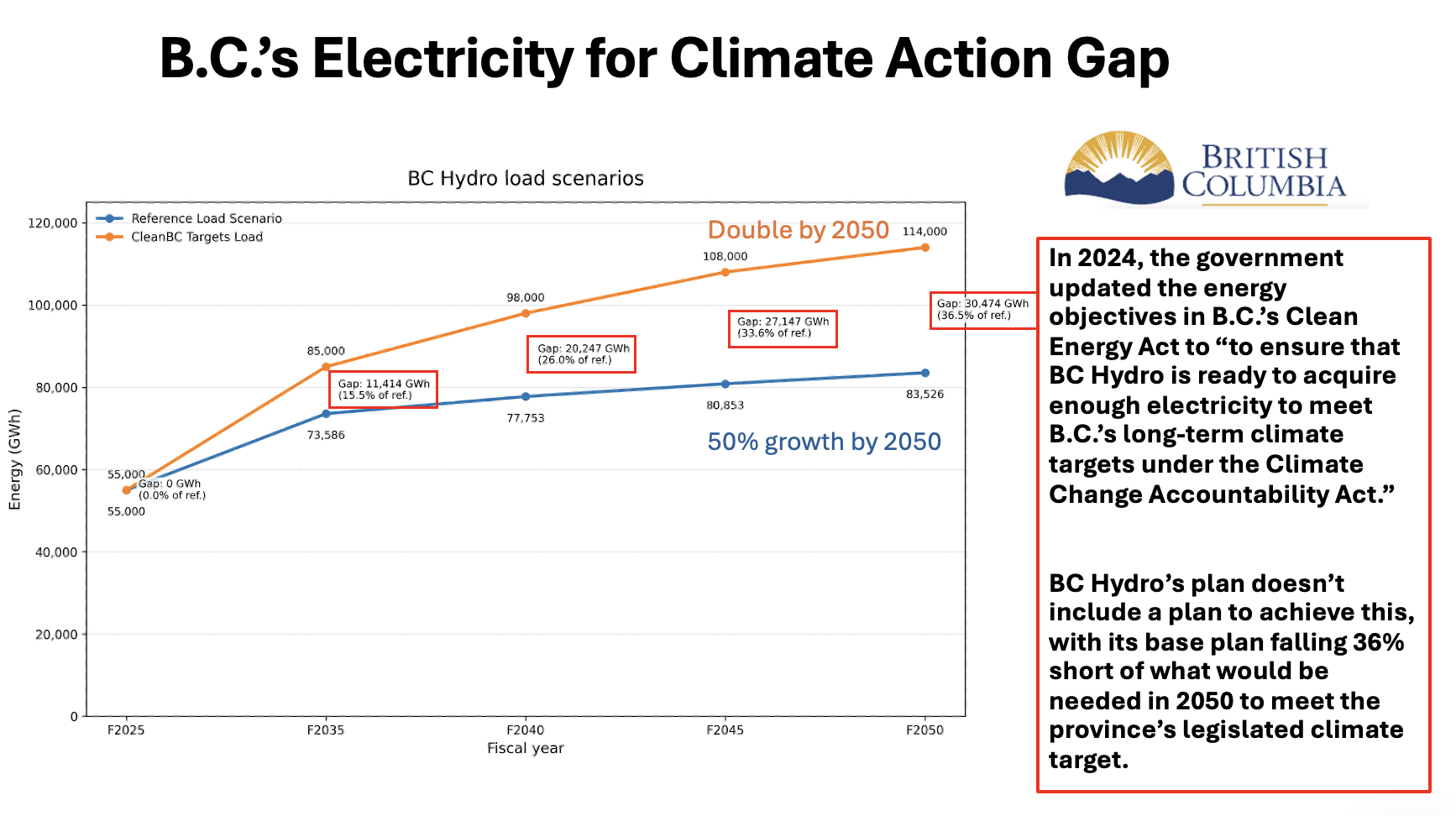
So it was downright baffling to see the Province and BC Hydro roll-out Powering Growth, Fueling Opportunity—billed as “a comprehensive plan to power growth, strengthen communities and support long-term economic development”—that only plans for 50 per cent growth in the province’s electricity system by 2050.
In the last election, the BC NDP’s platform committed to doubling electricity supply by 2050, echoing their government’s 2024 clean energy strategy, which noted, “While 2050 is more than two decades away, BC must and is beginning to plan today for a future where electricity use doubles by 2050 and overtakes fossil fuels as the largest energy source in the province.”
The 50 per cent growth plan is drawn from BC Hydro’s most recent Integrated Resource Plan’s (IRP) Reference Case scenario, the most likely future for electricity demand and, hence, supply requirements. While this may seem like a reasonable approach, it’s important to understand that this regulatory document is inherently conservative, borne from an understandable desire to avoid overbuilding the system and driving up power bills.
But as BC Hydro acknowledges in its IRP the risk of under-building is greater than the risk of over-building. Nonetheless, their 50 per cent growth plan is premised upon assumptions about economic growth and electrification that fall well short of the government’s ambitions.
In a new assessment of jurisdictions’ preparedness for growing industrial demand, the gap between the electricity requirements linked to 50 per cent of industrial projects in the connection queue (acknowledging not all will proceed) and the demand projections included in electricity plans was measured. Of the hydro-led systems assessed—B.C., Washington, Norway and Quebec—BC Hydro’s plan had the largest planning gap, at 110 per cent. Norway, meanwhile, had a gap of just 10 per cent, and Quebec’s was less than 10 per cent.
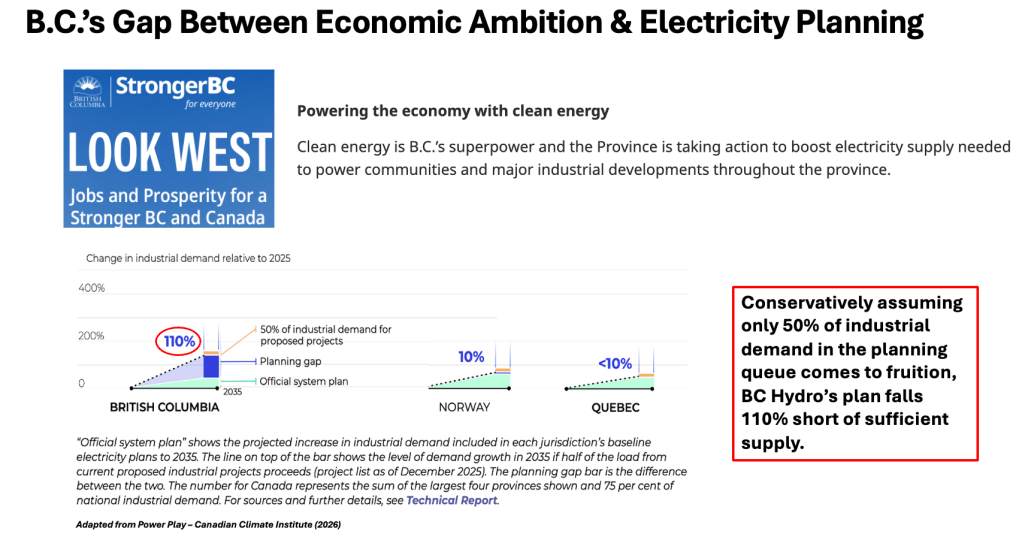
This should be cause for concern in the Premier’s office. A potential shortage of electricity puts the government’s economic ambition at risk, with future shortfalls of electricity serving as a potential brake on investment growth.
A similar story plays out with respect to electrification of homes and businesses—with heat pumps—and transportation, from transit to trucking to personal vehicles. B.C is far behind Norway when it comes to electrification, measured as the contribution electricity makes to meeting energy demand. In Norway, electricity is the largest source of energy, meeting 47 per cent of energy demand. In B.C., electricity is tied for third at 18 per cent (with biomass), behind refined petroleum products and natural gas (at 34 and 31 per cent, respectively). While electrification is often framed as a climate solution, the current energy price shock serves as a stark reminder of the energy security and affordability benefits of reduced reliance on oil and gas.
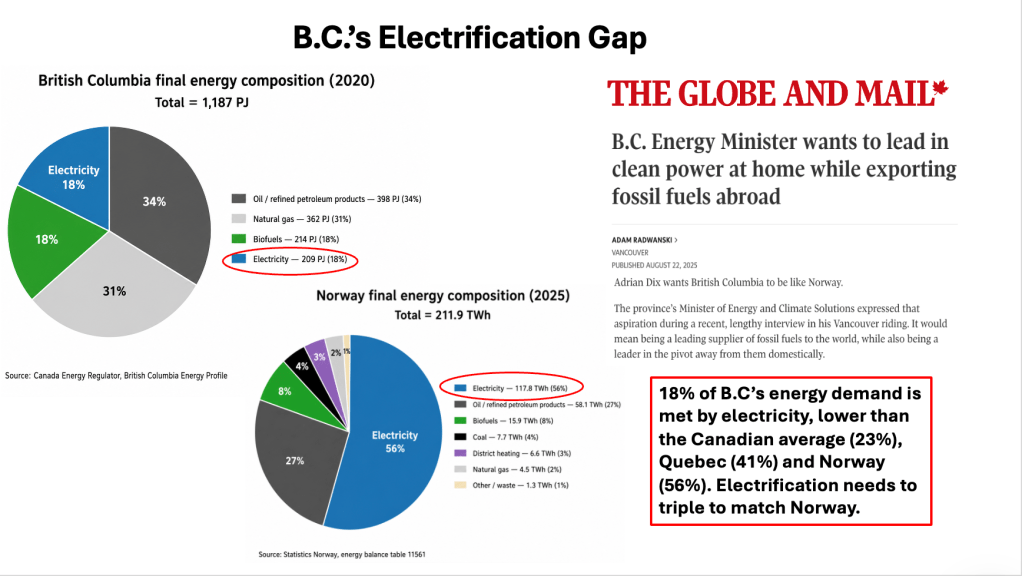
To fulfill the province’s economic and electrification ambitions we need to produce a lot more electricity and electrify much more of our energy use—for both, it’s on the order of a doubling from today. That matches the ambition of Prime Minister Carney’s Powering Canada Strong: A National Strategy for an Electrified Canadian Economy.
With a 98 per cent clean electricity grid, surging power demand, and a resource sector poised to boom, B.C. ought to be the first province to work in lock-step with the federal government to translate this strategy into action, leveraging the federal government’s triple-A balance sheet to help with the cost of doing so.
Failing to plan, is planning to fail. Demand can materialize much faster than new supply and transmission can meet it—the only way to avoid an electricity shortfall acting as binding constraint on economic and electrification growth is to plan and build aggressively and proactively.
A course correction is needed to put the province on a path to doubling electricity supply and doubling electrification to unlock economic growth, household affordability, and climate benefits for all British Columbians.
Mark Zacharias is a fellow at the Centre for Global Studies and Pacific Institute for Climate Solutions at the University of Victoria. Dan Woynillowicz is the principal of Polaris Strategy + Insight.

