Cutting through the Fog of War on Energy Transition

This essay was originally published in the May-June edition of Policy Magazine.

It’s been more than a year since Russia invaded Ukraine, precipitating a range of regional and global crises, not the least of which is “the first truly global energy crisis.” It has disrupted both energy supply and demand, resulting in energy price spikes, while damaging and shifting longstanding trading relationships.

As a result, we are confronted by new questions about the prospects for a global shift from fossil fuels to clean energy to combat the climate crisis: will a renewed focus on energy security slow or accelerate the energy transition? And what will this mean for global efforts to cut greenhouse gas (GHG) emissions?

To answer these questions and understand the implications, we must do our best to cut through the “fog of war” that has descended on the energy transition. As Carl von Clausewitz, a 19th-century Prussian general, said: “War is the realm of uncertainty; three-quarters of the factors on which action in war is based are wrapped in a fog of greater or lesser uncertainty. A sensitive and discriminating judgment is called for; a skilled intelligence to scent out the truth.”

To say the state-of-play on the energy transition has been dynamic is an understatement, but it is possible to cut through the fog and see where things stand, where we’re headed, and what it might mean for Canada.

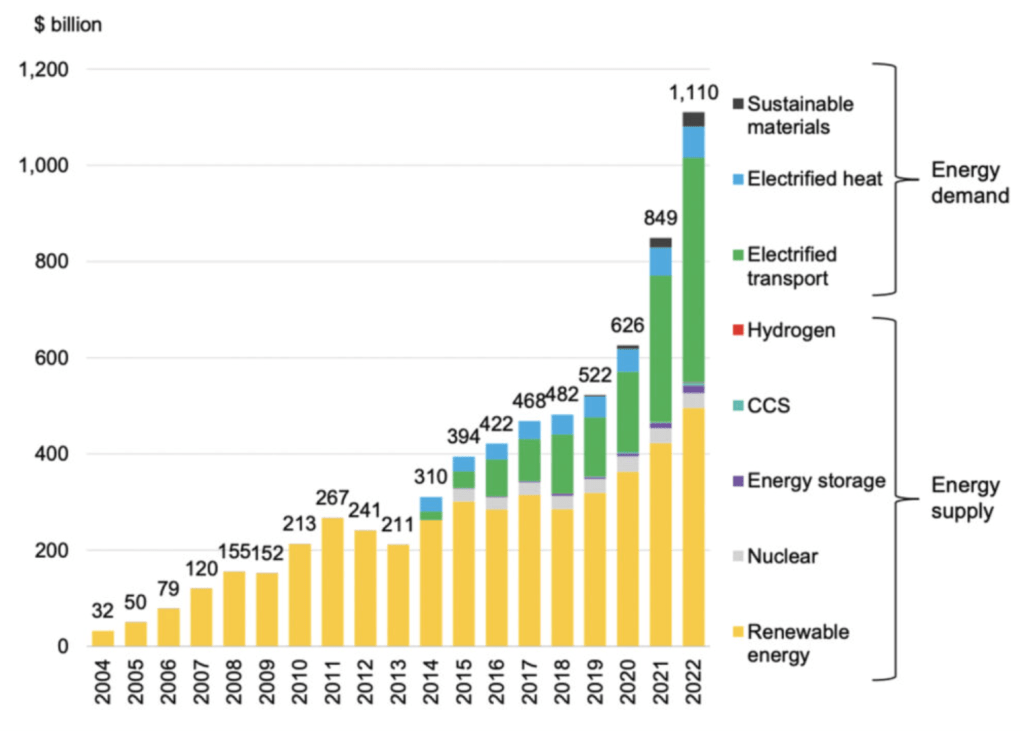
According to an analysis by BloombergNEF, last year marked the first time that as much money was invested in replacing fossil fuels as in producing more coal, oil and gas, with each garnering around US$1 trillion (Figure 1). On the clean energy side of the ledger, this was a 31 percent increase over investment in 2021. The biggest recipients of this capital were solar and wind (US$495 billion, up 17 percent) followed close behind by electric vehicles (EVs) (US$466 billion, up 54 percent). As for where this capital was deployed, nearly half (US$546 billion) was in China. If European countries are considered together, they tallied US$180 billion, and the US was home to US$141 billion.

Figure 1: Global investment (US$) in energy transition by sector, BloombergNEF

The energy transition investment total increases if you add investments in expanding and strengthening power grids (US$274 billion), clean energy supply chains and manufacturing (US$79 billion), and the $119 billion raised by clean-tech companies in equity financing. All included, investments driving the energy transition topped US$1.6 trillion last year.

Globally, wind and solar accounted for a record 12 percent of global electricity in 2022, and power sector emissions may have peaked, according to the think tank Ember. Drilling down into some specific examples, by the end of 2022 India was home to 199 gigawatts (GW) of wind and solar capacity (for context, Canada’s entire electricity system is about 150 GW), and they have announced plans for tendering 50 GW of renewable energy capacity per year for the next five years (i.e. adding up to 250 GW). Japan and South Korea both re-visited their energy plans in light of evolving energy markets and their own net-zero commitments and now aim to reduce reliance on both coal and LNG while boosting nuclear and renewable energy capacity. Electric vehicle adoption is taking off too, fueled by more selection (in 2022 more than 300 models were on offer), and by the end of 2022 a cumulative total of 27 million EVs were on the road, displacing more than 1.6 million barrels per day of oil in 2022, according to BloombergNEF.

With this progress, even if incremental, the delayers, who say climate solutions are too expensive, and doomers, who say it’s too late, can safely be discounted. As the International Energy Agency has found, while carbon dioxide (CO2) emissions grew by 0.9 percent in 2022, the rise in emissions was well below global GDP growth of 3.2 percent and would have been three times higher had it not been for strong growth in clean energy.

It seems quite evident that the war in Ukraine, like the COVID-19 pandemic, won’t derail the energy transition. To the contrary, European leaders have found a solution to their energy trilemma — achieving energy sustainability, affordability, and security — and it isn’t LNG, it’s a decarbonized energy system.

As European Commission President Ursula von der Leyen put it, “The quicker we switch to renewables and hydrogen, combined with more energy efficiency, the quicker we will be truly independent and master our energy system.” Within weeks of the Russian invasion, the EU unveiled the REPower EU Plan, which took the previous target of a 25 percent cut in natural gas use by 2030, relative to 2020, and more than doubled it to 56 percent. And the plan is working. Take heat pumps, for example, which replace gas boilers. In 2022, Europe led the world with 41 percent growth in heat pump sales (compared to global growth of 11 percent), with nearly three million sold. It seems Putin has done the near-impossible: make heat pumps sexy.

It seems quite evident that the war in Ukraine, like the COVID-19 pandemic, won’t derail the energy transition. To the contrary, European leaders have found a solution to their energy trilemma — achieving energy sustainability, affordability and security — and it isn’t LNG, it’s a decarbonized energy system.

Closer to home, the passage of the Inflation Reduction Act (IRA) in the United States—perhaps better thought of as the Industrial Revolution Act — will not only transform the American energy system, it will cause ripple effects around the world. With an estimated public investment of US$400 billion — in the form of tax incentives, loans, and grants — the IRA is expected to drive more than $1 trillion in private investment into the production and deployment of clean energy solutions, including (but not exhaustively) renewable energy, batteries, EVs, more efficient consumer appliances, hydrogen, and carbon capture and storage.

The head of investment at Bill Gates’ Breakthrough Energy Ventures, a climate solutions investment fund, said the IRA would lead to the creation of 1,000 new companies; 100,000 jobs were created in the six months since its passage on the way towards an estimated 9 million jobs. Hardly a week goes by without an investment announcement with links back to the IRA. Clichés like “game-changer” and “tipping point” are not overstatements. As Melissa Lott, director of research at Columbia University’s Center on Global Energy Policy, summed it up: “It is truly massive. It’s industrial policy. It’s the kitchen sink. It’s a strong, direct and clear signal about what the US is prioritising.”

Here in Canada, the course the federal government (but not all provincial governments) is charting is clear, as evidenced by its clean energy-oriented spring budget — effectively designed to compete with the IRA in a significant but targeted way — and ongoing efforts to secure new net zero-aligned industrial investments. Canada can and must compete and collaborate with our allies, most notably the Europeans and Americans. There is good reason to be bullish, and to double down: we have a head-start with our relatively clean electricity system and numerous renewable energy and technology options for its necessary expansion; we have the critical minerals needed for the energy transition and rank second in battery supply chain competitiveness, and we are home to entrepreneurial innovators, including the dozen companies that made the 2023 Global Cleantech 100 list.

Looking to the future, it’s clear that countries are poised to continue making progress in their efforts to pivot to clean energy and reduce GHG emissions, with implications for coal, oil and gas. As Fatih Birol, head of the IEA, wrote, “Russia’s efforts to gain political and economic advantage by pushing energy prices higher have spurred a major response by governments — not just in the EU but in many countries around the world — to speed up the deployment of cleaner and more secure alternatives.” As a result, projections in the IEA’s flagship annual World Energy Outlook released in late 2022 are already out of date. Where it foresaw, for the first time, a peak in fossil fuel demand before the end of the 2020s, the agency’s newest data indicates that peak is moving even closer.

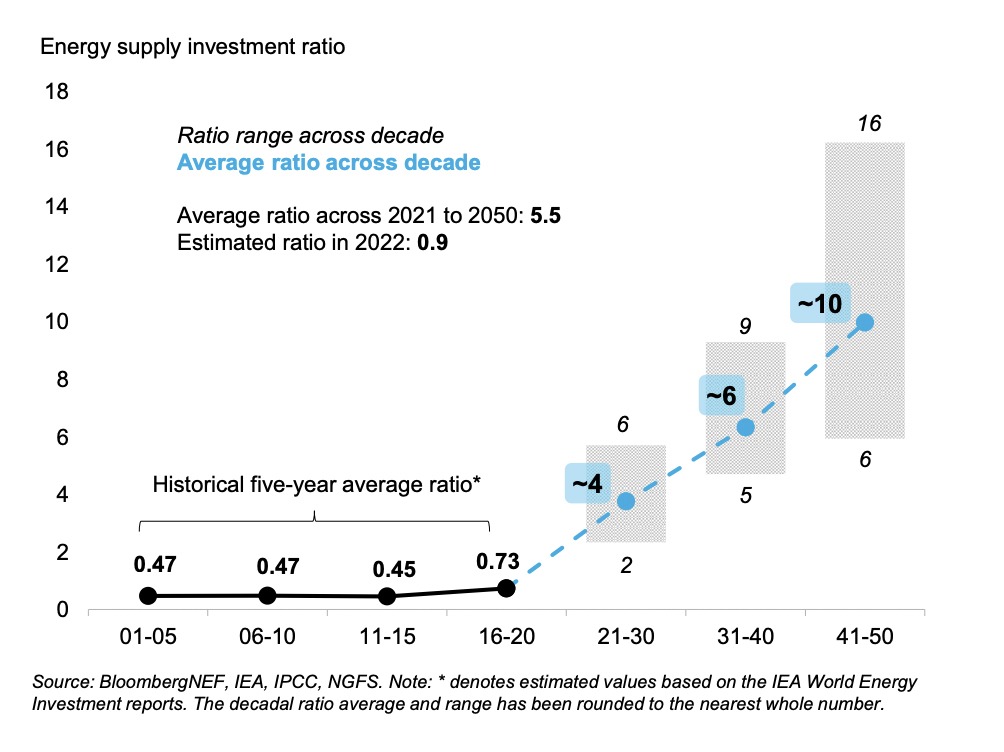
In the face of this optimism, it must be acknowledged that not every country or company is headed in the right direction, nor is the flight path to net zero emissions by mid-century likely to be a smooth one. While clean energy investment now matches fossil fuel investment, BloombergNEF finds that the investment ratio needs to be 4:1 (Figure 2) to ensure an orderly transition, in which growing clean energy supply offsets the required decline in fossil fuel supply. The Royal Bank of Canada, whose CEO advocates for an “orderly transition” is only achieving a ratio of 0.4:1.

Figure 2: Range of decadal energy supply investment ratio, 2001-2050, BloombergNEF

There are and will be challenges (see: critical mineral supply), setbacks (see: high natural gas prices perpetuating reliance on coal-fired power in Pakistan), and deviations from the transition (see: BP, Shell and Exxon backing off their climate targets). Such is the turbulence of transitioning to new supply chains, the power of path dependency, and the constraints on incumbents.

But the momentum towards net zero is building — 128 countries representing 88 percent of emissions, 92 percent of GDP and 85 percent of the world’s population have made net zero commitments — and the technology and investment trendlines are clear: the energy transition is accelerating. As the IEA’s Birol notes, “With this in mind, the push by some companies and governments to build new large-scale fossil fuel projects is not only a bet against the world reaching its climate goals — it is also a risky proposition for investors who want reasonable returns on their capital.”

The challenge for Canadian policymakers, business, and finance leaders — for our climate performance and economic competitiveness — is to decide where to place our bets, which will determine where we find ourselves when the fog of war on energy transition finally lifts.

All That Glitters Isn’t Gold

The recent visit to Canada by the Japanese Prime Minister sparked the latest round of debate about the prospects for increasing Canadian LNG production and export.

According to LNG champions, “Canada definitely has a business case for LNG.” The basic premise is that increasing LNG exports from Canada can help wean Japan off Russian gas and cut greenhouse (GHG) emissions by replacing coal. A win for the energy security of an ally, and a win for the climate.

The story goes on to say that Japan might even consider using Article 6 of the Paris Agreement to transfer credits for their GHG emission reductions to Canada, which could count towards achieving Canada’s 2030 target and offset the additional GHG emissions from producing and liquefying more gas. Win-win-win!

It sure sounds like a great story, but does it live up to the hype?

For policymakers, there are two, interrelated considerations at the intersection of the business case and the public interest.

The first is whether direct (e.g. tax breaks, grants) or indirect (e.g. helping foot the bill for new electricity transmission to electrify operations) public subsidies are warranted. The sweet spot is when the economic benefits are significant and fairly certain, and providing subsidies tips the scales on the business case for investment.

The second relates to climate change and the growing momentum towards clean (i.e. zero carbon) energy. What are the domestic GHG emission implications? What about global GHG emissions? And how do these considerations impact competitiveness and the risk of stranded assets?

Let’s take a closer look at where things are tracking in Japan, and how this ought to inform the debate about LNG exports from Canada.

According to the IEA’s 2022 World Energy Outlook, in a business-as-usual scenario (which they call Stated Policies, or STEPS), Japan’s demand for natural gas is projected to decrease by 39 million cubic metres (bcm)—or 38%— by 2030, relative to 2021, as the 2021 Strategic Energy Plan is implemented. This plan was formulated along two key themes: (1) achieving carbon neutrality by 2050 and the greenhouse gas emission reduction target, and (2) ensuring stable energy supply and reducing its costs while taking action against climate change. (IEA, 2022)

If Japan follows through on announced policies (the IEA’s Announced Policies Scenario, or APS)—which include the Green Transformation (GX) plan, which the Japanese Cabinet has subsequently approved—the drop in gas demand to 2030 is even more pronounced, falling by 57 bcm, or 58%. And it doesn’t stop there. By 2050 gas demand is projected to be just 17 bcm, an 83% drop from 2021.  It’s also critical to note that as demand gas drops, so too does demand for coal—falling by 40 (STEPS) to 46 million (APS) tonnes per year by 2030.

As we have witnessed in the EU’s response to the energy crisis resulting from the Russian invasion of Ukraine, energy security and climate security are no longer at odds. As the IEA put it, “this is a crisis where energy transitions are the solution, rather than the problem.” (IEA, 2022)

This is similarly evident in Japan’s plans for “working to reduce its energy security risks while pushing forward with its climate agenda through measures to decrease exposure to imported fossil fuels, increase its share of nuclear and renewables, and improve energy efficiency.” (IEA, 2022)

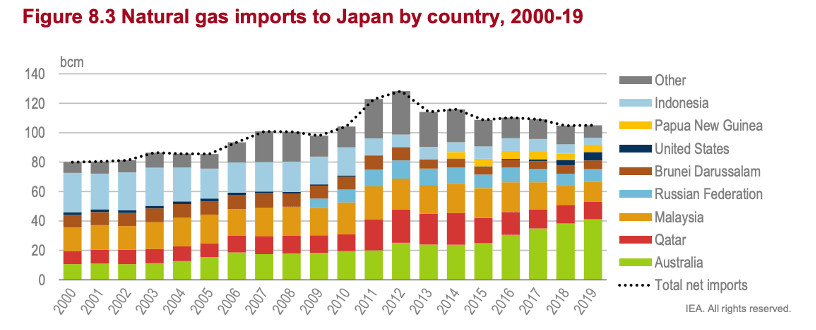
But if both gas and coal demand is falling, then the specific question at hand doesn’t have a climate dimension, it’s really just about replacing Russian gas with Canadian gas. And so we must ask ourselves: if the role of Canadian gas is simply to replace Russian gas, how will it fare as Japanese gas demand falls?

Japan really doesn’t import much Russian gas, so it won’t be long before there are more non-Russian suppliers than there is demand. Will Canadian gas still be able to compete with other suppliers in this scenario, or will Canadian LNG terminals end up as stranded assets?

Source: IEA

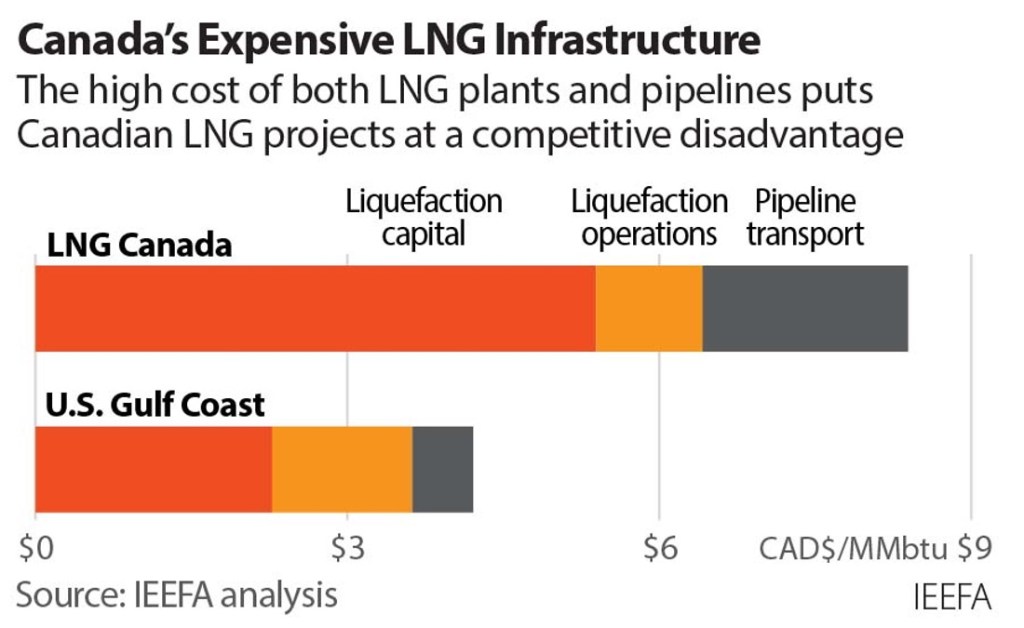
According to a recent analysis exploring the relative cost of Canadian versus American LNG, competing on cost will be challenging:

Source: IEEFA

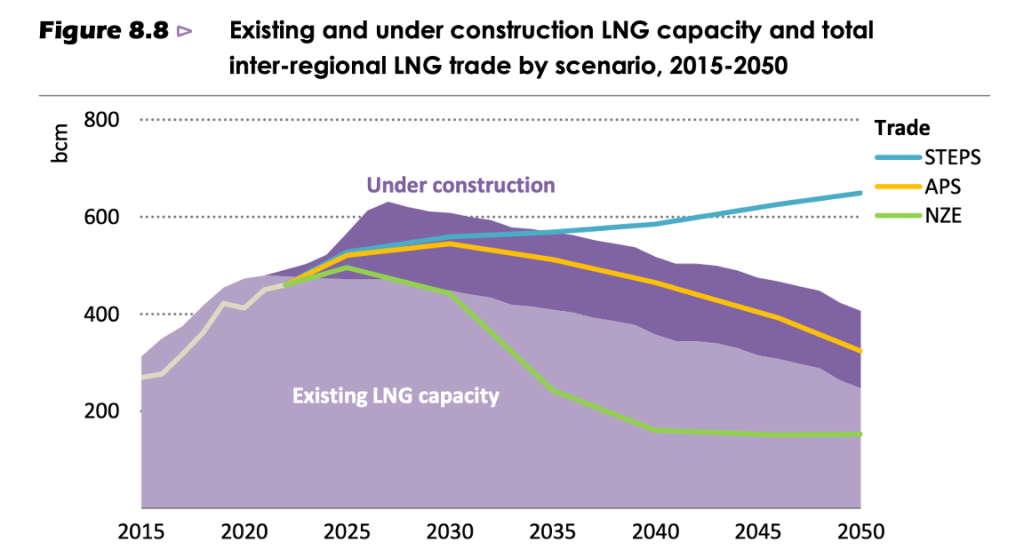
This raises questions about whether there’s enough certainty of success to justify public subsidies. It took several billion in subsidies to secure a final investment decision for Phase 1 of the LNG Canada project, but that was when the outlook for gas was much rosier than it is today. Back then the IEA was still touting the “golden age of gas.” Now, the IEA has declared “The golden age of gas is approaching the end.” (IEA, 2022)

How fast is it approaching that end? For LNG capacity, it appears we’re already there. According to the IEA, if governments follow through on policies they’ve announced (APS)—as Japan is doing—then existing and under-construction LNG facilities will already produce surplus LNG. The first phase of LNG Canada squeaks in, but anything beyond that is highly uncertain, with success premised upon governments backtracking on policy commitments.

Source: IEA

On this basis, the case for public subsidies to tip the scales on the business case and secure new investment is a weak one, fraught with risk to taxpayers.

Turning to the question of climate benefits, as noted above it’s clear that Japan’s interest in Canadian gas isn’t related to emission reductions, but enhancing energy security by replacing Russian gas.

As a result, the prospect of generating legitimate credits under Article 6 seems far-fetched. If both coal and gas demand is falling as nuclear and renewable power increase, how could it be demonstrated that Canadian gas was displacing coal that would otherwise have been burned, rather than replaced with nuclear or renewable power?

Meanwhile, GHG emissions in Canada will increase, either taking us further from achieving our climate targets or requiring other sectors—and citizens—to do more of the heavy lifting.

So things don’t look great, whether considering competitiveness or climate impacts. What business case there is for additional LNG investment in Canada is fraught with uncertainty and risk. If shareholders want to assume that risk, they are free to do so.

But policymakers ought to think twice about public subsidies that put taxpayer money at risk, money that might better support other opportunities that are lower risk and better align with the transition to net zero. As for our climate targets, it’s clear that there is no quid pro quo or net climate benefit resulting from LNG exports. Consequently, governments are well-advised to hold firm on ensuring that any additional LNG development fits within those targets, and the cost of doing so is borne by the industry (not taxpayers or other sectors).

Rachel Samson from the Institute for Research on Public Policy summed things up well, “With many risks facing an LNG project, private investors will focus on the lowest-cost projects with the greatest chance of realizing a return. If government subsidies are added to the mix, projects that are less likely to be competitive – and thus less resilient to shifting market demand – could move forward. If those projects don’t make it, taxpayers are not only short the money invested but they also miss out on the benefits that could have been realized from investing the funds elsewhere.”

Dig down and what seems like a great opportunity may not live up to the hype. All that glitters isn’t gold.

Lost in Transmission?

I’ve been thinking a lot lately about the magnitude of the challenge we face in scaling up clean electricity generation and transmission to achieve net zero. Generation gets a lot of attention but without transmission to get clean electrons to all the things we need to electrify, we’re stuck.

So it was great to see Bill Gates put a spotlight on transmission, and distill the opportunity/challenge to its essence: “If you care about climate change, you should care about transmission.”

BC offers an interesting case study.

Giga Metals is a Vancouver-based mining company focused on metals critical to the batteries needed for electric vehicles and energy storage. The company is advancing the Turnagain Nickel-Cobalt Project, which is located 65 km east of Dease Lake, and has the potential to produce 33,000 tonnes of battery grade nickel annually over 35 years. The project caught the eye of Mitsubishi, which took a stake in the project last summer.

The aim for the project is for it to be a world-class leader in low-carbon nickel production via a number of strategies, not the least of which is using clean electricity to power shovels, drills and (when possible) the mine fleet. (As an off-topic but interesting aside, it also includes a novel opportunity for CO2 sequestration through mineral carbonation, working with UBC’s Greg Dipple, who has created Arca, a company that proposes to use waste from critical metal mines to capture and store CO2 permanently by speeding up the natural process of carbon mineralization).

If the mining operation is going to be largely electrified, it needs access to BC Hydro’s clean power, which requires an approximately 160 kilometer extension of the existing 287 kV Northwest Transmission Line to the project site. The alternative? An LNG-fuelled power plant that would be more expensive and polluting.

Source

Simple, right? Wrong.

Last week the challenge of aligning new transmission with industrial demand was thrust into the spotlight when LNG Canada declared that it will have to burn gas to power its Phase 2 compressors (if in fact, it proceeds) because it won’t have access to sufficient power to electrify. While subsequent coverage leads me to believe this claim may just be a thinly veiled ploy to get taxpayers and/or ratepayers to shoulder the cost of transmission (rather than actually being about timing), it did precipitate a clear acknowledgment from BC Hydro that it faces a “chicken and egg” dilemma: “There is a potentially big demand for clean power from industry. Industries can’t commit to electrification without adequate transmission, and BC Hydro can’t commit to building new transmission without big industrial customers making final investment decisions.”

When the alternative to plugging into clean power is burning fossil fuels, this has material implications for both achieving BC’s legislated climate targets and competing for investment dollars that increasingly consider the carbon intensity of potential investments.

Timeliness is critical. So is certainty. And so while BC Hydro is, to their credit, trying a new approach to overcome the “chicken and egg” challenge, they’re going to need some help.

That’s where BC’s new Minister of Energy, Mines & Low Carbon Innovation, Josie Osborne, comes in. She has some key deliverables in her mandate letter that could prove critical. Amongst other things, she has been asked to:

  • Develop and implement a climate-aligned energy framework for B.C. with an overall goal of maximizing our province’s production of clean energy to use at home and for export.
  • Improve timing and transparency of permitting processes to support sustainable economic development while maintaining high levels of environmental protection, aligned with cross-government work on permitting led by the Minister of Water, Land and Resource Stewardship.
  • Work with BC Hydro to implement its Electrification Plan and to ensure the province is well positioned to electrify B.C.’s economy and industry, including options for Indigenous ownership and/or equity interest in BC Hydro infrastructure and Indigenous partnership in clean energy projects.
  • Work with the BC Utilities Commission to identify an appropriate role for the Commission in supporting B.C.’s clean energy transition, in alignment with our province’s climate goals to achieve net zero by 2050 and affordability objectives.
  • Support B.C.’s mining sector by launching the Mining Innovation Hub and expedite a provincial critical minerals strategy that positions British Columbia to take advantage of the emerging clean global economy.

If Minister Osborne can make progress on these tasks, while ensuring they remain aligned with the DRIPA and its associated Action Plan, BC will be in a unique and remarkably competitive position to align its economy and energy system with net zero.

It’s not a small “to-do” list but it is a “must do” list: unless and until we figure out how to navigate these challenges our electrification ambitions risk being lost in transmission.

How to Be a Climate Optimist

Blueprints for a Better World

This book review was originally published in Alberta Views.

“I’m a climate optimist. There’s nothing starry-eyed or Pollyanna-like about it. It’s not a slogan or a marketing pitch.” This opening passage from Calgary author Chris Turner’s most recent book, How to Be a Climate Optimist: Blueprints for a Better World, might strike many as surprising. After all, the news is full of stories about climate-fuelled extreme weather wreaking havoc on lives and livelihoods.

The news media reality, however, is that “if it bleeds, it leads,” and the news is more likely to cover the controversy and conflict of the energy transition than the good-news stories that are cause for optimism. But they’re out there, and in this book, Turner does a brilliant job of capturing and conveying them, drawing upon his two decades on the “climate solutions beat.”

From the backstory of Germany’s Energiewende, that country’s transition to a low carbon, reliable and affordable energy supply which unleashed the potential of solar power, to the “energy transition Disneyland” of Bornholm, a Danish island that has served as a living laboratory exploring what a better, cleaner energy system looks like, to the quiet but rapid rise of China to become the world’s largest manufacturer and installer of wind turbines and solar panels, Turner captures the confluence of technological, economic and political forces that have made the clean energy transition an inevitability. The question, clearly, is not whether the transition will happen, but how quickly.

Of course, how quickly the energy transition unfolds isn’t just a function of technology or economics; it requires political will. Or as Turner puts it, “only political will?” In sections aptly titled “Political Will is Not the Easy Part,” “Climate Politics 101 (Or: How I Learned to Stop Worrying and Love Politics and Then Hate Politics and Then Realize I Needed Politics No Matter How I Felt about it),” and “The Highly Qualified, Necessarily Compromised Thrill of Climate Victory,” Turner draws upon both observations and experience over the past two decades, from Germany’s Bundestag to UN climate conferences, and from the grassroots of Calgary municipal politics to the pragmatic climate politics of Prime Minister Justin Trudeau. It is a refreshingly honest accounting of the realpolitik of climate progress.

Turning from politics to policy, Turner lays out how, by harnessing solutions from energy efficiency codes to electrifying—that is, substituting clean electricity for fossil fuels—just about everything, the next decade holds the promise of being “not a flight from danger, but a march, even a race, toward a better world.” Embedded in this, as it is throughout the book, is a central thesis drawn from Denmark’s achievements (from Copenhagen’s embrace of cycling to that country’s leadership in offshore wind power): “the best solutions arise not by stopping what you don’t want but by seeking what you do want. Not by reducing emissions or eliminating fossil fuels but by building a new kind of grid, developing better kinds of transport, assembling a much better way of living.”

Like Turner, I’ve spent the past two decades engaging at the intersection of climate change and energy transition, and like him I’m a self-described climate optimist who shares his conclusion: “The energy transition will make its greatest strides yet, and it will make the world better in all the ways I’ve observed and in many I can’t even imagine yet.” But we are in the minority—a 2021 poll found two-thirds of Canadians are pessimistic about climate change. If you’re in this camp or know somebody who is, read or gift this book—readers will be hard-pressed to come away from it without a feeling of climate optimism.

A Prescription for Climate Progress: Stubborn Optimism, and More Stubborn Commitment

This essay was originally published in Policy Magazine.

Heat domes. Atmospheric rivers. In 2021, my vocabulary expanded in ways I hadn’t anticipated. Living in British Columbia, I witnessed the cascading impacts to services and supply chains that accompanied the heatwaves, wildfires and flooding, and felt the sense of helplessness shared by most British Columbians as the toll in lives and livelihoods ticked upwards with each disaster.

While some commentators characterize these catastrophic weather events as our “new normal,” climate scientists remind us that this would imply a new and static stability that simply doesn’t exist. If anything, the “new normal” is that there is no normal anymore. The amount of carbon pollution we have and continue to pump into the atmosphere is changing our climate and the weather systems it fuels. 

This isn’t to suggest that efforts to cut carbon pollution and take climate action are futile. To the contrary, it simply reinforces the imperative to strengthen and accelerate efforts. As Prime Minister Justin Trudeau noted in his speech at the COP26 climate change negotiations in Glasgow, “The science is clear: we must do more, and faster.”

To Canada’s and the Prime Minister’s credit, these words aren’t simply good intentions, but are backed up by a track record of effort, accompanied by clear and specific commitments to do more. To some, this might seem a controversial statement. You don’t have to look far to find criticism of the Canadian government’s climate efforts – that it has been too slow, too weak, and simply hasn’t reduced national carbon pollution (at least not yet). As leaders of the NDP and Green Party trumpeted in last fall’s election, the Trudeau Liberals were more about pretty words than real action.

But as Charles Dickens wrote in Great Expectations, “Take nothing on its looks; take everything on evidence. There’s no better rule.” In this spirit, a brief recap is in order:

Following their 2015 election win, the Liberals brought Canada into the Paris Agreement and drew provinces together behind the Pan-Canadian Framework on Clean Growth and Climate Change. They introduced a national price on carbon pollution, defended it up to the Supreme Court of Canada, and have committed to a schedule of increases out to 2030. They have secured a phase-out of coal-fired power at home and championed the Powering Past Coal Alliance internationally, advanced a Clean Fuel Standard to clean up fuel for gas vehicles, and made major strides to enable more Canadians to ditch their gas vehicles, buy electric replacements and keep them charged.

Their 2019 election platform promised even more, and they delivered. The Healthy Environment, Healthy Economy climate plan released in late 2020, and supported by new investments in the 2021 budget, put Canada on track to achieve a 36 percent reduction below 2005 levels by 2030 (beating the original Paris target of 30 percent). They could have coasted but understood more action is both needed and expected of Canada. So, in keeping with the Paris Agreement requirement to review and increase ambition on a five-year cycle, they filed a new target of a 40 to 45 percent pollution reduction by 2030. 

Yet despite all this effort, carbon pollution isn’t yet falling in Canada. What gives?

Regrettably, what the federal government does (or doesn’t do) is not the sole determinant of emissions in our federation. It’s a shared responsibility with provinces, and during the Liberals’ tenure, the provinces that contribute the most pollution — Alberta and Ontario — both saw changes in government that led to a rollback of provincial climate efforts and a deliberate effort to stymie federal efforts. 

But equally significant is the reality that policies, programs, and regulations take time to design and, when implemented, don’t create change overnight — there is an unavoidable lag. But consult experts, and they’ll tell you that the policies now being advanced will begin to reduce pollution in short order, and those reductions will grow and accelerate as they take hold.

Fortunately, we don’t just have to go on faith and expert analysis. The passage of the Canadian Net zero Emissions Accountability Act will provide Canadians with more clarity than we’ve ever had about what efforts the government is making, and of the expected results from those efforts. While most public and media attention to this legislation focused on its targets, its real value is in the obligation it creates for the government to establish and publish detailed plans, and to prepare progress reports for milestone years, with the first report due by no later than the end of 2023.

The first of these plans was intended to be due by the end of 2021 but considering the timing of the federal election and COP26, the government exercised its right to a 90-day extension and so will deliver it by the end of March. The plan will not only incorporate all the policies and programs described above, it will also include the big promises made in the Liberals’ 2021 election platform: 

  • Mandating the sale of zero-emission vehicles so that 100 percent of new light-duty vehicles (cars, pickups, etc.) sold in Canada are zero emission by 2035 and at least 50 percent by 2030;
  • Developing emissions standards for heavy-duty vehicles that are aligned with the most ambitious standards in North America, and requiring that 100 percent of selected categories of medium- and heavy-duty vehicles be zero emission by 2040;
  • Capping emissions from the oil and gas sector at current levels and requiring that they decline at the pace and scale needed to get to net zero by 2050;
  • Developing a plan to reduce methane emissions across the broader Canadian economy in support of the Global Methane Pledge and the goals in Canada’s climate plan, reducing oil and gas methane emissions by at least 75 percent below 2012 levels by 2030 through an approach that includes regulations, as well as regulating methane landfill emissions and reducing agricultural methane emissions; and
  • Transitioning to a net zero emitting electricity grid by 2035.

While many of these commitments include targets that extend beyond 2030, the plan is required to include projections of the annual greenhouse gas emission reductions resulting from those combined measures and strategies—including projections for each economic sector. For the first time, there will be clear and quantitative transparency around the scale and timing of emission reductions, which Canadians can use to both hold the government accountable and to evaluate its progress. By the next election, whenever it may be, we should be able to see how big the gap is between ambition and action, words and results.

Finally, three decades after Canada ratified the United Nations Framework Convention on Climate Change (1992) and two decades after Canada ratified its first emission reduction commitment in the Kyoto Protocol (2002), we are beginning to get the institutional and administrative pieces in place to track federal climate action efforts. And I say “beginning” because the job isn’t yet complete. As helpful as the Net Zero Emissions Accountability Act is in establishing plans and tracking performance against them, it doesn’t explicitly require or drive the changes in governance—both the form and function of government—needed to execute these plans.

But on this front, there are some signs of progress nonetheless, from the establishment of a Cabinet Committee on Economy, Inclusion and Climate to a focus on climate action in the mandate letters of all ministers, including specific deliverables for some. Similarly, climate change is increasingly being considered in everything from government procurement to policy development, and the Healthy Environment, Healthy Economy plan pledged to “Apply a climate lens to integrate climate considerations throughout government decision-making” by ensuring government decisions “consider climate ambitions in a rigorous, consistent and measurable manner…that ensures that government spending and decisions support Canada’s climate goals.” 

Following the 2021 election, the decision to shift the former environment minister, Jonathan Wilkinson, to the Natural Resources portfolio, and Steven Guilbeault to Environment was broadly perceived as a strong signal that the government intends to move quickly on its campaign promises. Notably, the creation of a parliamentary secretary role, held by Julie Dabrusin, to work with both the natural resources and environment ministers creates a connective tissue between these ministries that holds interesting potential for better political integration. 

Meanwhile, in the public service, the government has established a climate secretariat within the Privy Council Office (PCO), though its mandate and influence aren’t yet clear. Optimally, it should have a focus on policy integration and efficiency, with responsibility for navigating competing priorities, trade-offs, and synergies among federal departments, helping to develop climate plans and shepherding their implementation.

A recent report by the International Institute for Sustainable Development and the Canadian Institute for Climate Choices, Greater than the sum of its parts: How a whole-of-government approach to climate change can improve Canada’s climate performance, quite rightly notes that achieving Canada’s climate targets “will require the active involvement of departments as disparate as Finance, Infrastructure, Transport, Natural Resources, Environment and Climate Change, Agriculture and Agri-Food, Crown-Indigenous Relations and Northern Affairs, Public Safety and Emergency Preparedness, Employment and Social Development, and others, necessitating a coordinated approach to ensure coherent implementation of climate strategy.” Informed by detailed case studies of whole-of-government efforts in the UK, US and B.C., it offers important recommendations for implementing a cohesive and effective whole-of-government approach to climate change, which the Prime Minister’s Office and PCO would do well to follow:

  1. The success of a whole-of-government climate initiative depends on sustained executive leadership directing departmental priorities and inter-departmental coordination.
  2. An effective whole-of-government climate initiative requires adequate funding, a clear mandate, and capacity to enact change across departments.
  3. An effective whole-of-government climate initiative requires effective and empowered personnel acting in whole-of-government structures.
  4. The mandates of participating departments must align, or be brought into alignment, with the mandate of the whole-of-government climate initiative.
  5. A whole-of-government climate initiative should report publicly on its progress and be as transparent as possible about its deliberations, findings, and research.

Over the course of its first six years in office, the Liberal party effectively advanced numerous policies and programs that promise to deliver emission reductions in the coming years. Equally important, they created a system of transparency and accountability we have never previously had at the federal level. Hopefully, by the time the next election rolls around, Canadians will be able to get a clear view of what has been promised, what has been delivered, and whether the two line up.

Much as we might hope that B.C’s climate annus horribilis was an exception, years without climate-fuelled disasters somewhere in Canada are more likely to be the exception. Nonetheless, a Leger poll from November 2021 found that 75 percent of Canadians believe we still have time to put measures in place to stop climate change. They, like me, appear to be what Christiana Figueres, the diplomat who brokered the Paris Agreement, calls “stubborn optimists.” 

F. Scott Fitzgerald wrote that, “The test of a first-rate intelligence is the ability to hold two opposing ideas in mind at the same time and still retain the ability to function. One should, for example, be able to see that things are hopeless yet be determined to make them otherwise.” In the era of climate disruption, these words ring true, although in my view it’s less a measure of intelligence than emotional fortitude and resilience. 

What all of this means for the federal government is that expectations are high for it to deliver on its climate action ambitions and commitments, and it has the public support it requires to move forward assertively. But adding to the challenge is the obvious imperative to not only try to cut pollution to prevent the worst impacts of climate change, but to prepare for and manage the impacts that climate change is already imposing. Consequently, in parallel to advancing an ambitious policy package to cut pollution, it will need to deliver reactive emergency support in response to floods and fire, while simultaneously making investments in climate-proofing infrastructure and delivering programs that will make Canadians safer and more resilient in the face of a changing climate.

It’s no small task, but I remain stubbornly optimistic. 
Skills

Over the past two decades, I’ve had the opportunity to try my hand at a wide range of things, developing and honing a diverse set of skills.

Expertise in energy & climate change policy

I blend practical energy and climate policy knowledge with a principled, pragmatic approach to getting results. I have experience with diverse policy approaches for cutting pollution, driving innovation, and adopting behavioural and technology solutions.

Systems-thinking & problem-solving

I am quick to see the big picture and understand how its pieces connect and interact. Able to absorb a breadth and depth of qualitative and quantitative information, I explore relationships and connect the dots, finding creative solutions to challenging problems.

Strategic communications

I am a creative communicator, with the ability to craft accessible messages for specific audiences—from citizens to businesses to policymakers and politicians. In addition to strong writing skills, I’m an experienced public speaker and media spokesperson. 

Managing relationships & building support for durable solutions

With a diplomatic style, I bridge the interests of diverse constituencies, both between various stakeholders, as well as within institutions. Personable and engaging, I build strong, trust-based relationships.

Services

Every client’s needs are different, and so every relationship I have and project I deliver is built-for-purpose, drawing upon my diverse skills, knowledge, and network.

My service offerings include:

STRATEGY – From campaigns to communications, government relations to alliance-building, an effective strategy is central to your success. Using a variety of tools & approaches, I can help you build, execute & evaluate your strategic approach.

COMMUNICATIONS – Effective communication is the bridge between a good idea & a successful idea. By understanding your audience & crafting tailored messages—for briefing notes & opinion editorials, presentations & press releases—I can help ensure your voice is heard.

STAKEHOLDER RELATIONS – Securing durable public policy requires broad support from businesses, associations, & civil society organizations. To achieve this, I can help convene, build bridges & forge effective multi-stakeholder alliances.

RESEARCH – Whether developing policy options or effective messaging, I offer research & analysis that provides the information & insight needed to give you—& those you’re trying to influence—the confidence required to make decisions.

ENGAGING GOVERNMENTS – Relationships with politicians & officials are key—I know what it takes to build & maintain them. I can support your efforts to effectively engage the government, from lobby days to submissions, to helping you prepare for a committee hearing.

And if you need something I don’t offer, I have a diverse group of colleagues willing to partner to build the team you need.